Wonderful March: A Handwritten Font for Elegant, Human-Centered Design
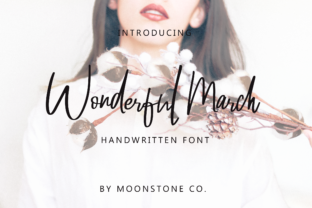
Wonderful March is a carefully crafted handwritten typeface that balances spontaneity with refinement. Unlike many script fonts that lean heavily into either playful informality or rigid calligraphic formality, Wonderful March occupies a distinct middle ground—fluid enough to feel personal and expressive, yet controlled enough to convey sophistication and intention. Its letterforms feature subtle variation in stroke weight, gentle tapering on terminals, and natural entry/exit strokes that mimic the rhythm of skilled penmanship. This isn’t digitized calligraphy; it’s a thoughtfully designed interpretation of handwriting—designed to feel human, not hurried.
What Sets Wonderful March Apart
At its core, Wonderful March distinguishes itself through restraint and consistency. Many handwritten fonts sacrifice legibility or visual cohesion for the sake of “authenticity”—introducing erratic spacing, exaggerated flourishes, or inconsistent baseline alignment. Wonderful March avoids those pitfalls. Its lowercase a, g, and y use classic, open forms rather than overly stylized alternatives, supporting readability at moderate sizes. Uppercase letters maintain presence without dominance, making them suitable for titles or monograms where hierarchy matters. The font includes standard ligatures and contextual alternates—but they activate subtly, enhancing flow without drawing attention to themselves.
This measured approach gives Wonderful March versatility across contexts where tone and trust matter: luxury skincare packaging, boutique wedding invitations, editorial headers for lifestyle brands, or even refined website hero text. It doesn’t shout—it invites closer attention. That makes it especially effective when paired with clean, neutral sans-serif companions (like Inter, Lora, or Work Sans) in multi-font systems.
Fitting Into Real-World Design Workflows
Wonderful March works best when used intentionally—not as a default “handwritten” fallback, but as a deliberate voice within a broader typographic strategy. For example, a small-batch candle brand might use Wonderful March for product names and scent descriptions on labels, while relying on a crisp geometric sans-serif for ingredient lists and certifications. Similarly, a wedding stationery designer may apply Wonderful March to names and dates in invitation suites, reserving simpler scripts or serif fonts for RSVP details and accommodation information.
Its OpenType features support common professional needs: discretionary ligatures for polished word endings (e.g., “and”, “the”), stylistic alternates for customizing character personality (like a more upright or slanted t), and full language support for Western European languages. It’s available in a single weight—regular—with no bold or italic variants. That limitation isn’t a flaw; it reflects the font’s purpose. Handwriting rarely has true bold or italic equivalents—and forcing those variations would undermine its authenticity.
When Wonderful March Fits—and When It Doesn’t
Wonderful March shines in projects where warmth, craftsmanship, and quiet confidence are central values. Think artisanal food branding, heritage-inspired fashion labels, literary magazine mastheads, or mindfulness app interfaces. In these cases, its elegance supports—not distracts from—the message. It also performs well in print applications with high-resolution output, where fine stroke details remain visible and intentional.
Conversely, it’s less suited for environments demanding high functional legibility at small sizes or under time-constrained reading conditions. You wouldn’t choose Wonderful March for body copy in a long-form article, legal disclaimers, mobile navigation labels, or data-dense dashboards. Its rhythm and spacing aren’t optimized for rapid scanning. Likewise, if your project calls for strong contrast—such as pairing a bold display font with a delicate script—Wonderful March’s singular weight may limit flexibility compared to families offering multiple optical sizes or weights.
It’s also worth noting that Wonderful March is a desktop font, licensed for use in design software and static web assets (e.g., embedded via @font-face). It does not include variable font axes or web-optimized WOFF2 subsets by default—so developers integrating it into websites should plan for file size, loading strategy, and fallback behavior. While perfectly serviceable for headings and short decorative text, it shouldn’t be expected to replace system fonts for dynamic or responsive interface elements.
Comparing Approaches: Script Fonts in Context
Handwritten fonts fall along a spectrum—from highly structured formal scripts (often inspired by copperplate or Spencerian traditions) to casual, sketch-like lettering meant to evoke immediacy. Wonderful March sits comfortably in the mid-spectrum: more structured than freeform brush scripts like Brittany Signature or Quicksand, but looser and warmer than tightly kerned formal scripts like Playfair Display Italic or Great Vibes. That positioning gives it broader appeal than extremes on either end.
Compared to other elegant handwritten options, Wonderful March avoids two common tradeoffs: excessive ornamentation (which can date quickly or overwhelm minimalist layouts) and over-simplification (which risks feeling generic or insincere). Its letterforms retain individuality without veering into idiosyncrasy—making it easier to pair, scale, and adapt across touchpoints. That balance is why designers often return to Wonderful March for projects requiring both emotional resonance and professional polish.
Practical Considerations for Evaluation
- Legibility at scale: Test Wonderful March at your intended usage sizes—especially in print mockups or on actual devices. Its charm depends on visibility of stroke modulation; if details blur or merge, consider adjusting size, weight contrast, or background treatment.
- Pairing compatibility: Try it alongside your primary text font in real layout contexts—not just side-by-side character charts. Does hierarchy emerge clearly? Does spacing feel harmonious, or does one font visually “pull” away from the other?
- Licensing scope: Verify whether your intended use (e.g., client deliverables, SaaS platforms, merchandise) falls within the license terms. Some handwritten fonts restrict commercial redistribution or web embedding without extended licensing.
- Workflow integration: If you’re using Figma, Adobe Creative Cloud, or web development tools, confirm how smoothly Wonderful March imports and renders—particularly with ligature activation and glyph substitution.
Making a Thoughtful Choice
Selecting a handwritten font is rarely about finding the “most beautiful” option—it’s about identifying the most appropriate voice for a specific audience, medium, and message. Wonderful March earns its place when those priorities include elegance without stiffness, humanity without informality, and distinction without distraction.
It won’t solve every typographic challenge. It won’t replace a robust UI font system or serve as a workhorse for long-form content. But when applied with care—in logos that reflect craft, packaging that signals care, or digital experiences that prioritize feeling over function—it delivers something increasingly rare: typography that feels both considered and kind.
If your project asks viewers to slow down, to notice detail, to sense intention behind every mark—Wonderful March offers a grounded, graceful answer. And if your needs point elsewhere—toward bolder contrast, greater functional range, or faster readability—that’s equally valid. The strongest design decisions come not from chasing trends or defaults, but from matching tool to task with clarity and respect for both audience and craft.