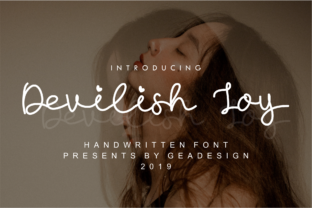
Devilish Joy: A Handwritten Font That Earns Its Place in Strategic Design
Devilish Joy isn’t just another playful script font—it’s a deliberately crafted typographic tool with distinct emotional resonance and functional clarity. Designed as a lovable handwritten font, it carries warmth, approachability, and subtle confidence without slipping into cutesy irrelevance. For professionals who rely on visual language to shape perception—whether launching a brand, guiding learners, converting visitors, or reinforcing trust—Devilish Joy offers more than aesthetic charm. It delivers measurable impact when aligned with intention, audience, and context.
Why Devilish Joy Works Where Other Scripts Fall Short
Many handwritten fonts sacrifice legibility for flair or authenticity for consistency. Devilish Joy avoids both pitfalls. Its letterforms maintain generous spacing, open counters, and balanced weight distribution—making it highly readable at medium sizes (16–24px) in digital interfaces and print collateral alike. Unlike overly decorative alternatives, it doesn’t demand attention; it invites engagement. That distinction matters when your goal is connection—not distraction.
This reliability supports real-world objectives: a small business owner building email campaigns can use Devilish Joy for subject lines to increase open rates by signaling human voice over corporate automation. An educator designing worksheets might apply it to instructions or encouragement notes—reducing cognitive load while reinforcing empathy. A publisher selecting fonts for a lifestyle magazine’s pull quotes gains tonal cohesion without sacrificing editorial seriousness.
Strategic Use Cases: When Devilish Joy Adds Value
Not every project benefits from handwritten typography—and that’s the first strategic filter. Devilish Joy shines where authenticity, warmth, or personalization directly support outcomes. Consider these grounded applications:
- Brand Voice Reinforcement: If your brand positions itself as nurturing, intuitive, or artisanal—think wellness coaching, handmade goods, or early-childhood education—Devilish Joy can echo those values in headlines, logos, or social bios. Used consistently across touchpoints, it becomes part of your brand’s sensory signature.
- Customer-Facing Microcopy: Buttons labeled “Let’s Begin” or “You’ve Got This” gain sincerity when set in Devilish Joy. It softens transactional language without undermining clarity—ideal for onboarding flows, error messages, or confirmation screens where tone affects retention.
- Educational & Instructional Materials: In learning platforms or workshop handouts, Devilish Joy helps segment conceptual content from procedural text. Pair it with a clean sans-serif (e.g., Inter or Lato) for body copy—creating visual hierarchy that guides attention and reduces mental friction.
- Creative Direction for Collaborators: When briefing designers or developers, specifying Devilish Joy signals precise expectations about tone. It eliminates vague requests like “make it friendly” and replaces them with an actionable, tested asset—saving revision cycles and aligning cross-functional teams faster.
What to Consider Before You Commit
Using Devilish Joy without alignment to goals introduces risk—not technical risk, but strategic misalignment. A law firm using it for legal disclaimers may unintentionally undermine authority. A fintech dashboard applying it to financial data labels could compromise scanability and erode user confidence. These aren’t flaws in the font; they’re mismatches between tool and purpose.
Ask yourself before deploying Devilish Joy:
- What outcome am I trying to influence? (e.g., increased sign-ups, reduced support tickets, stronger brand recall)
- Who is interpreting this text—and what assumptions do they bring? (e.g., parents evaluating a preschool app may read warmth as competence; enterprise buyers may read it as lack of scale)
- Where does this appear in the user journey? (e.g., hero section = high-impact, low-risk; regulatory footer = low-impact, high-risk)
- How does it pair with supporting typefaces? (Devilish Joy performs best with neutral, highly legible companions—not competing scripts or ultra-thin fonts)
Testing is non-negotiable. Run A/B variants of a landing page headline—one in Devilish Joy, one in your primary brand font—and measure time-on-page, scroll depth, and conversion lift. You’ll quickly learn whether its charm translates into action—or simply sits prettily in the background.
Practical Integration Tips for Real Workflows
Adopting Devilish Joy isn’t about swapping fonts—it’s about integrating a voice. Here’s how seasoned practitioners do it well:
- Start narrow, then expand. Apply it first to one high-visibility, low-risk element: a newsletter greeting, a testimonial banner, or a CTA button. Measure response. Refine. Then scale.
- Define usage rules—not just “where,” but “how.” Example: “Devilish Joy is used only for primary headlines up to 36px, never for body text or numbers. Always paired with Roboto for supporting copy.” Clear constraints prevent dilution.
- Optimize delivery. Self-host the web font and subset characters if you’re only using English letters and common punctuation. This keeps load times low—a practical necessity for SEO and Core Web Vitals.
- Respect accessibility. Never rely solely on color contrast to distinguish Devilish Joy text. Ensure sufficient contrast ratio (at least 4.5:1 against background), and avoid using it for critical UI labels where screen readers or low-vision users depend on predictable structure.
Long-Term Positioning: Beyond Trendy Appeal
Fonts age. What feels fresh today can feel dated in 18 months—if chosen for novelty alone. Devilish Joy endures because its design balances personality with restraint. It doesn’t shout. It leans in. That makes it adaptable across evolving platforms: equally effective in a printed product catalog, an Instagram Story overlay, or a slide deck presented to investors.
Over time, consistent, thoughtful use builds recognition—not just of the font, but of the values it represents in your work. Customers begin to associate its rhythm with your reliability. Teams internalize its role as a signal of human-centered thinking. And when competitors chase flashier trends, your grounded application of Devilish Joy quietly reinforces stability and care.
A Final Strategic Note
Typography is never neutral. Every font choice communicates something—intentionally or not. Devilish Joy communicates warmth, craftsmanship, and quiet confidence. But its power lies not in its appearance alone, but in how deliberately you wield it. Use it to soften barriers—not obscure meaning. To personalize—not patronize. To reflect voice—not replace strategy.
When aligned with clear goals, tested with real users, and governed by consistent rules, Devilish Joy becomes more than a font. It becomes part of your operational discipline: a small, repeatable decision that compounds over time into stronger communication, deeper trust, and more resilient branding. That’s not whimsy—that’s leverage.