Emerttons: A Handwritten Font with Graceful Charm for Thoughtful Design Choices
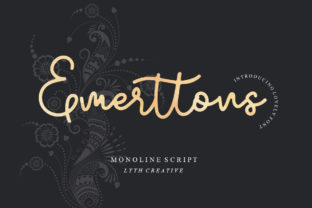
Emerttons is a carefully crafted handwritten font—soft, expressive, and intentionally delicate. It’s not built for bold headlines or high-contrast signage, but for moments where warmth, personality, and quiet elegance matter. Its letterforms flow with subtle variation in stroke weight and rhythm, evoking the natural imperfections of ink on paper. That human touch is central to what makes Emerttons distinct: it doesn’t mimic handwriting as a gimmick—it interprets it with restraint and intention.
What Sets Emerttons Apart From Other Handwritten Fonts
Many handwritten fonts fall into one of two categories: highly energetic scripts meant for youthful branding, or ultra-formal calligraphic styles suited for luxury invitations. Emerttons occupies a quieter middle ground. Its lowercase ‘a’, ‘g’, and ‘y’ feature gentle loops—not tight or exaggerated—and its baseline subtly sways, giving text a breathing quality rather than rigid uniformity. Unlike bolder script fonts that demand attention, Emerttons invites closer reading. It works because it feels personal without feeling casual, refined without feeling distant.
This balance stems from thoughtful design decisions: moderate x-height, open counters, and consistent but unobtrusive slant. These traits improve legibility at medium sizes (14–24 pt), especially in body text or short quotes—something many decorative scripts sacrifice for flair. Emerttons also avoids extreme ligatures or alternate characters that can complicate typesetting. Its OpenType features are minimal but functional: standard ligatures and contextual alternates that enhance flow without requiring manual intervention.
Where Emerttons Fits in Real-World Projects
Emerttons shines in contexts where tone matters as much as content. Consider a boutique wedding stationery suite: pairing Emerttons with a clean, neutral sans-serif (like Inter or Lato) for body text creates contrast that feels intentional, not jarring. Or imagine a small-batch skincare brand using Emerttons for product names and ingredient highlights—its softness reinforces natural, gentle messaging without leaning into clichéd “handmade” tropes.
It’s less effective in environments demanding high readability at distance or small sizes—think wayfinding signage, mobile app interfaces, or data-dense reports. Its delicate strokes lose definition below 12 pt in print or on low-resolution screens. Similarly, long-form editorial use (e.g., full blog posts or eBooks) may feel visually fatiguing over time, as the lack of strong typographic hierarchy can blur paragraph boundaries.
Comparing Emerttons With Related Styles
When evaluating handwritten fonts, designers often weigh three dimensions: expressiveness, legibility, and versatility. Emerttons leans toward the latter two—moderately expressive, reliably legible at appropriate sizes, and adaptable across media when used deliberately.
- Compared to highly decorative scripts: Fonts with dramatic flourishes or irregular baselines offer more visual impact—but often at the cost of consistency and scalability. Emerttons trades that drama for cohesion, making it easier to maintain brand voice across multiple touchpoints.
- Compared to minimalist handwritten fonts: Some ultra-thin, monoline scripts prioritize subtlety over character. Emerttons retains enough stroke contrast and organic variation to feel hand-drawn while remaining grounded in readability.
- Compared to brush or marker-style fonts: These convey energy and immediacy but can read as informal or even juvenile depending on context. Emerttons’ restrained pressure modulation gives it broader tonal range—suitable for both heartfelt notes and refined packaging.
Practical Tradeoffs to Consider
No font excels in every scenario—and Emerttons is no exception. Its strengths come with clear constraints:
- Language support limitations: Emerttons includes Latin-based characters (Western European languages) but lacks extended diacritics, Cyrillic, or Greek glyphs. Projects requiring multilingual copy—especially those with accented characters beyond common French, Spanish, or German usage—may need supplemental typefaces or custom extensions.
- Weight and width options: It ships in a single upright style with no bold, italic, or condensed variants. This simplifies pairing decisions but limits typographic hierarchy within a single-family system. You’ll likely pair it with another font family to establish contrast for headings, captions, or emphasis.
- Digital rendering variability: On some Windows systems or older browsers, fine strokes may appear uneven or slightly blurred due to subpixel rendering differences. Testing across devices—particularly iOS Safari and Chrome on Android—is advisable before final deployment.
When Emerttons Is Likely the Right Choice
Emerttons fits best when your goal is to communicate sincerity, care, or understated sophistication—not urgency, authority, or technical precision. It’s well-suited for:
- Branding projects where authenticity and approachability are core values (e.g., independent bookshops, artisan food producers, wellness practitioners).
- Print collateral like greeting cards, recipe cards, or limited-edition packaging—where tactile quality and visual harmony outweigh functional demands like scanning or machine readability.
- Digital micro-content: social media quote graphics, email headers, or landing page subheadings where text is brief and purposefully evocative.
- Designers who value craft over convenience—those willing to adjust tracking, line height, and color contrast thoughtfully rather than relying on auto-kerning or default settings.
When Another Option Might Serve Better
Emerttons may not align with your needs if:
- You require accessibility-first typography. While readable at appropriate sizes, its low stroke contrast and organic baseline make it less ideal for users relying on screen readers or high-contrast modes—especially compared to humanist sans-serifs designed with WCAG guidelines in mind.
- Your project involves dynamic or generated text (e.g., user profiles, live event schedules, database-driven product labels). Consistency and predictability matter more than stylistic nuance in these cases.
- You’re working under tight technical constraints—such as embedded systems, legacy CMS platforms with limited font upload support, or strict brand guidelines mandating system fonts only.
- The emotional tone you’re aiming for is confident, modern, or authoritative. Emerttons conveys tenderness and intimacy more readily than strength or innovation.
Making an Informed Decision
Choosing a font like Emerttons isn’t just about aesthetics—it’s about alignment. Ask yourself: What feeling should this text evoke? Who will encounter it, and under what conditions? How much control do you have over layout, size, and surrounding elements?
If you’ve sketched rough layouts and found Emerttons enhancing—not competing with—the message, that’s a strong signal. Try setting real copy—not placeholder text—in context: a product description, a short testimonial, a newsletter headline. Print it. View it on a phone. Zoom in. Does it hold up? Does it feel like part of the story, or just decoration?
Remember, Emerttons doesn’t need to carry the full weight of your design system. Used selectively—as a signature accent, a naming device, or a moment of pause—it deepens resonance without overwhelming clarity. Its value lies not in versatility at all costs, but in doing one thing well: lending grace to the written word.