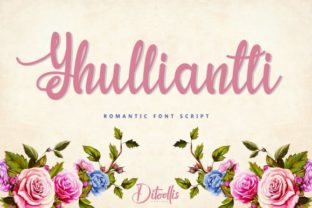
Yhulliantti: A Fresh, Cute, and Adorable Font for Thoughtful Design Choices
Yhulliantti is a contemporary display font designed with charm and clarity in mind. It falls squarely within the “friendly handwritten” category—but avoids the uneven pressure variation or exaggerated flourishes common in many script fonts. Instead, Yhulliantti balances soft curves, consistent stroke weight, and subtle bounce—giving it a hand-drawn warmth without sacrificing legibility at moderate sizes. Its lowercase letters feature gentle upward lifts on terminals, and its capitals carry just enough personality to stand out without overwhelming surrounding text. What sets Yhulliantti apart isn’t novelty for novelty’s sake—it’s how thoughtfully its cuteness serves function.
What Makes Yhulliantti Distinct in Practice
Unlike fonts that lean heavily into nostalgia (think chalkboard or vintage diner styles), Yhulliantti feels current—not trendy. It doesn’t mimic calligraphy tools or emulate analog imperfections; rather, it uses digital precision to evoke sincerity and approachability. The spacing between characters is generous but not loose, supporting readability in short headlines, social media graphics, product labels, or invitation suites. Its x-height is comfortably tall, which helps maintain visual presence even when scaled down to 24–36px for web banners or mobile interfaces.
Yhulliantti includes standard Latin characters, basic punctuation, and numerals—but no extended language support or OpenType features like stylistic alternates or ligatures. That’s a deliberate tradeoff: simplicity keeps file size light and rendering predictable across platforms, especially in email clients or older CMS environments where advanced font features often fail silently.
Where Yhulliantti Fits Among Similar Options
When evaluating fonts with a similarly warm, inviting tone, designers often consider options across three overlapping categories: friendly sans-serifs (e.g., Quicksand, Nunito), gentle scripts (e.g., Pacifico, Caveat), and illustrated or decorative display faces (e.g., Bungee Shade, Poppins Rounded). Yhulliantti sits between the second and third—more structured than most scripts, yet more expressive than most rounded sans-serifs.
Compared to Pacifico, Yhulliantti has less contrast between thick and thin strokes, making it more versatile in mixed-font pairings. Where Pacifico can dominate a layout or clash with tighter body text, Yhulliantti tends to recede just enough to let supporting type breathe. Against Caveat—which offers multiple weights and variable axis support—Yhulliantti is simpler, with only one weight and no optical sizing adjustments. That limits flexibility in complex typographic hierarchies but reduces decision fatigue for smaller projects.
It also differs meaningfully from rounded sans-serifs like Nunito or Varela Round. Those fonts prioritize neutrality and accessibility, excelling in UI and long-form reading. Yhulliantti does neither. It’s not optimized for interface labels or paragraph text. Its strength lies in moments of intentional emphasis—where tone matters as much as information.
Strengths and Real-World Fit
Yhulliantti shines in contexts where authenticity and emotional resonance are part of the message—not just decoration. Consider a small-batch bakery launching seasonal packaging: Yhulliantti on a honey label conveys care and craft without seeming overly polished or corporate. Or an indie podcast branding its episode thumbnails—its rhythm and friendliness reinforce a conversational, human-centered voice.
It works well in digital spaces where attention is fleeting but tone must land quickly: Instagram story headers, email subject lines previewed on mobile, or animated SVG logos where clean vector paths matter. Because its outlines are smooth and moderately condensed, it scales cleanly across resolutions without pixelation or blurring—even in low-DPI print outputs like stickers or tote bags.
Pairing Yhulliantti effectively requires restraint. It pairs best with neutral, highly legible sans-serifs (e.g., Inter, Lato, or even system fonts like -apple-system) used for body copy or captions. Avoid pairing it with other decorative or high-contrast fonts—doing so risks visual competition and undermines its quiet charm.
Limitations and When to Look Elsewhere
Yhulliantti isn’t built for every use case—and recognizing its boundaries is key to using it well. It lacks bold or italic variants, so establishing strong typographic hierarchy beyond size and color requires careful planning. If your project needs clear visual distinction between headings, subheadings, and body text—especially in responsive layouts—Yhulliantti may require supplemental type choices or thoughtful design scaffolding.
It’s also not ideal for accessibility-critical applications. While legible at headline sizes, its connected lowercase forms and modest letter separation reduce scannability for users with dyslexia or low vision. WCAG-compliant interfaces should avoid relying on Yhulliantti for primary navigation, form labels, or instructional text.
For multilingual projects—including languages with diacritics, extended Latin characters, or non-Latin scripts—Yhulliantti’s limited glyph set becomes a functional constraint. You’ll need fallback fonts or separate typography strategies for Spanish accents, French cedillas, or German umlauts. Similarly, if your workflow depends on variable font technology (e.g., adjusting weight or width dynamically), Yhulliantti won’t integrate smoothly.
Decision Factors: Is Yhulliantti Right for Your Project?
Ask yourself these questions before selecting Yhulliantti:
- Is tone central to your message? If warmth, playfulness, or handmade authenticity align with your brand voice—or help differentiate you from competitors—Yhulliantti supports that intention without overstatement.
- Do you need versatility across weights, widths, or languages? If yes, consider expanding your font stack or choosing a family with broader support.
- Will this appear alongside substantial body text? Yhulliantti functions best as a focal point—not as part of a dense typographic system. Ensure your supporting typeface provides strong contrast in form and function.
- What’s your delivery environment? If deploying via web font services (e.g., Google Fonts, Adobe Fonts), verify loading performance and fallback behavior. Yhulliantti’s lightweight nature helps here—but always test on slower connections and legacy devices.
Also consider timing. Yhulliantti suits early-stage branding exploration, where mood boards and concept mockups benefit from expressive typography. It’s less suited to enterprise-wide design systems requiring strict scalability, auditability, and cross-departmental consistency.
Practical Testing Tips Before Committing
Before finalizing Yhulliantti in a live project, test it in context—not just as isolated samples. Try these steps:
- Set real content: Use actual headlines and subheads—not “Lorem ipsum”—to assess rhythm and fit within your layout constraints.
- Check contrast: Render Yhulliantti against your intended background colors at multiple sizes. Soft pastels or off-whites often complement its warmth better than stark black-on-white.
- Validate rendering: Preview in Safari, Firefox, and Chrome—especially on macOS and iOS, where font hinting differences can subtly affect baseline alignment.
- Print a sample: Output a physical proof at 100% scale. Screen rendering often flatters delicate details that blur or fill in during ink transfer.
Finally, compare side-by-side with one or two alternatives—not to find the “best,” but to clarify what each brings to your specific goals. Does another option offer better language coverage? More nuanced weight progression? Stronger accessibility metrics? Let those comparisons inform—not override—your intent.
Yhulliantti isn’t a universal solution. But for designers who value clarity of expression, respect for context, and quiet confidence in typographic choice, it offers something increasingly rare: a font that feels both fresh and familiar, cute without cliché, and adorable without sacrificing purpose.