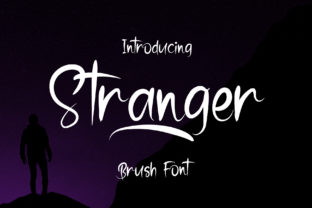
Stranger: A Handwritten Font with Irregular Charm
Stranger isn’t just another handwritten font—it’s a deliberate departure from predictability. Its strokes vary in weight, angle, and spacing in ways that feel human, not algorithmic. Letters tilt slightly, terminals flick or taper unexpectedly, and baseline alignment breathes rather than rigidly conforms. That irregularity isn’t a flaw; it’s the core feature. When used intentionally, Stranger adds texture, personality, and quiet confidence to work that might otherwise blend in.
What Makes Stranger Stand Out—Beyond “Handwritten”
Most script fonts aim for legibility, elegance, or speed. Stranger aims for presence. It doesn’t try to mimic calligraphy tools or simulate brush pressure—it behaves like handwriting made by someone who’s focused on meaning, not perfection. The lowercase g has an open, looping tail; the uppercase S starts thin and swells mid-stroke; the dot over the i sits slightly off-center, like a thoughtful afterthought. These aren’t bugs—they’re design decisions rooted in authenticity.
Because it avoids uniformity, Stranger resists visual fatigue. In long-form digital interfaces, it’s best used sparingly—but in short bursts (headlines, quotes, labels, packaging accents), it creates memorable contrast. It also scales well: at 24px, it feels warm and approachable; at 72px+, its idiosyncrasies become expressive anchors on a page or screen.
Creative Uses That Go Beyond Decoration
Stranger works when it serves a purpose—not as window dressing, but as a functional voice. Here’s how different creators apply it:
- Bloggers & educators use Stranger for pull quotes and section headers—pairing it with clean sans-serifs (like Inter or Open Sans) to highlight key insights without overwhelming readers.
- Small business owners integrate it into product labels, café chalkboard menus, or workshop handouts—where warmth and approachability matter more than corporate polish.
- Freelance designers layer Stranger in mockups for artisanal brands (ceramics, small-batch coffee, handmade paper goods) to reinforce craft and individuality.
- Marketers deploy it selectively in email subject lines or social banners—just one word (“You’re invited”, “New batch”, “Open now”)—to trigger attention through subtle visual surprise.
It’s rarely the *only* font in a system—and shouldn’t be. Stranger shines brightest when paired with something grounded: a neutral serif for body text, a sturdy geometric sans for navigation, or even monospace for technical asides. That contrast is where its character gains clarity.
Keeping It Effective—Not Just Eccentric
Irregularity invites experimentation—but without guardrails, it can undermine communication. Here’s how to keep Stranger clear and audience-friendly:
- Limit scope. Use it for headlines, subheads, or short callouts—not paragraphs, captions, or UI buttons requiring quick scanning.
- Test readability early. At smaller sizes (under 18px), test on multiple devices. If letters like a, e, or o start merging visually, step back and increase size or switch to a simpler alternative.
- Respect hierarchy. If your main headline uses Stranger, don’t apply it to secondary headings or body copy. Let it hold singular emphasis.
- Check contrast. Its thinner strokes need sufficient color contrast against backgrounds—especially on digital screens. Avoid light gray on white or yellow on cream.
One practical tip: export Stranger as SVG for web use when applying subtle animations (e.g., staggered letter fade-ins on scroll). Its organic shape responds well to lightweight motion—unlike rigid fonts that look jarring when animated.
Variations in Tone—Same Font, Different Intent
Stranger adapts based on context—not because it changes, but because you do. Consider these real-world shifts:
- A nonprofit newsletter uses Stranger only for the sender’s name in the signature (“— Maya, Community Lead”)—adding humility and personhood to an otherwise formal update.
- A music festival poster sets the lineup in Stranger, but tightens letter-spacing by -10 units and increases line-height slightly—keeping energy high while preserving legibility from 10 feet away.
- An online course landing page applies Stranger to the core value proposition (“Learn by doing—not watching”) in bold weight, then switches to a crisp mono font for bullet points and pricing—balancing heart and clarity.
The font doesn’t carry tone alone. You set it with color, spacing, placement, and surrounding type. Stranger gives you expressive material—you provide the intention.
Where It Fits—and Where It Doesn’t
Stranger excels in contexts where trust is built through perceived authenticity: personal branding, indie publishing, local service websites, creative portfolios, and educational resources aimed at adult learners. It supports messages about growth, imperfection, curiosity, or craft.
It’s less effective—or requires careful handling—in highly regulated spaces (legal disclaimers, medical instructions), enterprise dashboards, or multilingual interfaces where consistent glyph rendering matters across scripts. It also needs thoughtful localization: some accented characters may require manual kerning adjustments in European languages.
If your project values precision over personality—like a financial dashboard or technical documentation—Stranger likely isn’t the right tool. But if your goal is to signal “this was made by a person, for people,” it’s hard to beat.
Getting Started—Practical Next Steps
You don’t need a full redesign to try Stranger. Start small:
- Add it to one section of your website’s homepage—a testimonial banner or mission statement.
- Swap your standard email signature font for Stranger (just your name), using a 16px size and #333 text color.
- In your next presentation, use it for slide titles only—keep body text in a highly legible sans-serif.
- Print a single-page zine or workshop handout with Stranger for headers and a clean serif for content—then hand-write a few marginal notes beside it. Let the font spark analog extension.
No font guarantees impact—but Stranger gives you permission to prioritize character over consistency, and humanity over uniformity. Used with focus, it doesn’t shout. It leans in.