Bethoven Font: A Light, Elegant Handwritten Typeface with Contemporary Charm
Typography is more than just letters on a screen or page—it’s emotion, identity, and intention made visible. Among the growing family of modern handwritten fonts, Bethoven stands out for its rare balance of lightness, elegance, and authenticity. Designed to feel both personal and polished, Bethoven isn’t just another script font—it’s a thoughtful typographic tool that bridges warmth and professionalism. Whether you're crafting a wedding invitation, branding a boutique café, or designing a mindful wellness app, Bethoven invites readers in with quiet confidence and understated grace.
What Is Bethoven—and Why Does It Feel So Authentic?
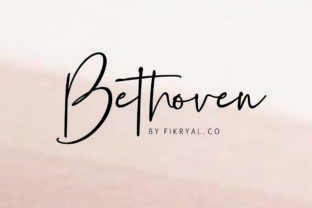
Bethoven is a lightweight, elegant handwritten font crafted with natural stroke variation, subtle irregularities, and soft terminals—hallmarks of genuine pen-on-paper writing. Unlike overly ornate scripts or rigid calligraphic revivals, Bethoven avoids excessive flourishes. Instead, it leans into cozy authenticity: letters breathe, spacing feels intuitive, and curves flow without stiffness. Its lowercase ‘a’, ‘g’, and ‘y’ carry gentle, open shapes; its ascenders and descenders extend with delicate restraint—not dramatic, but expressive.
This authenticity isn’t accidental. The design process involved studying real handwriting samples—from journal entries to artisanal signage—to capture organic rhythm and human imperfection. That’s why Bethoven doesn’t look “generated” or “AI-perfect.” It looks lived-in, like something written with care, not algorithmic precision.
The Contemporary Edge: Where Tradition Meets Modern Design
While rooted in handwriting tradition, Bethoven is unmistakably contemporary. Its letterforms are clean and legible at small sizes—unlike many script fonts that blur or collapse below 16px. It includes OpenType features like contextual alternates and ligatures, allowing designers to fine-tune flow and avoid repetitive character patterns (e.g., two consecutive “t”s won’t look identical). These details make Bethoven highly functional—not just decorative.
Its light weight is especially significant in today’s digital landscape. Heavy scripts can overwhelm UIs, while ultra-thin fonts often lack readability. Bethoven sits comfortably in the middle: airy enough for minimalist layouts, substantial enough for confident hierarchy. In responsive web design, it scales gracefully across devices—especially when paired with a neutral sans-serif for body text (think Inter, Poppins, or Lato).
Where Bethoven Fits in Real-World Applications
Understanding where and how to use Bethoven helps unlock its full potential. Below are practical, everyday contexts where its charm shines—without sacrificing clarity or credibility.
Branding & Small Business Identity
- Cafés & bakeries: Bethoven on a chalkboard menu or packaging evokes handmade quality—think “locally roasted” coffee beans or “small-batch granola.”
- Wellness studios: Yoga centers, meditation apps, or holistic therapists use Bethoven in logos and email headers to signal calm, intention, and human-centered care.
- Independent publishers: Book covers for memoirs, poetry collections, or illustrated journals gain intimacy and voice through Bethoven’s gentle rhythm.
Digital Experiences & UI Design
In user interfaces, Bethoven excels as a display font—not for paragraphs, but for moments that need emotional resonance: hero headlines, onboarding greetings, or celebratory microcopy (“You’re all set!” or “Welcome back”). Its legibility on retina screens and compatibility with modern CSS (font-feature-settings, variable font support in newer versions) makes it developer-friendly too.
Print & Stationery
From wedding suites to thank-you cards, Bethoven adds sincerity without formality. Because it’s designed with generous x-height and open counters, it remains readable even in fine-print details like RSVP instructions or venue maps. And unlike many script fonts, Bethoven includes full Latin character sets, numerals, punctuation, and multilingual support—including accented characters used in French, Spanish, and Portuguese—making it viable for global creative projects.
Common Misconceptions About Handwritten Fonts Like Bethoven
Many people assume handwritten typefaces are inherently “unprofessional,” “hard to read,” or “only for weddings.” Bethoven challenges all three assumptions:
- “It’s not serious enough for business.” Not true. When used intentionally—as a logo accent, headline, or signature element—Bethoven conveys approachability, creativity, and attention to detail. Think of brands like Cult.fit or Glossier, which pair handwritten elements with clean layouts to express brand warmth without compromising authority.
- “Handwritten fonts don’t work digitally.” Bethoven was engineered for screen use. Its hinting, spacing, and contrast were optimized for web rendering—no pixelation, no awkward kerning jumps between sizes.
- “All script fonts look the same.” Far from it. Bethoven’s specific combination of light weight, low contrast, and soft terminals distinguishes it from bolder scripts (like Pacifico), tighter formal scripts (like Great Vibes), or quirky casual fonts (like Amatic SC). Its uniqueness lies in its quiet confidence—not loud personality, but steady presence.
How to Use Bethoven Thoughtfully (and Avoid Overuse)
Like any expressive font, Bethoven gains power through restraint. Here’s how to honor its intent:
- Pair it wisely: Combine Bethoven with a highly legible, neutral sans-serif (e.g., Inter, Manrope, or Work Sans) for body copy. Avoid pairing it with other decorative or script fonts—clutter dilutes its impact.
- Reserve it for emphasis: Use Bethoven for headings, quotes, logos, or short calls-to-action—not long paragraphs or data tables.
- Test readability early: Preview at 14–18px on mobile. If letters begin to merge or lose distinction, scale up or switch to a supporting font.
- Consider licensing: Bethoven is available under commercial licenses via reputable foundries. Always verify usage rights—especially for SaaS platforms, client deliverables, or embedded apps.
Bethoven in the Broader Typographic Landscape
In an era saturated with bold, geometric, and AI-generated type, Bethoven represents a meaningful counterpoint: human-centered typography. It reflects a cultural shift toward authenticity, slowness, and tactile sensibility—even in digital spaces. Designers and developers aren’t just choosing a font; they’re choosing a tone, a value system, a way of connecting.
Educationally, Bethoven also serves as an excellent case study in type design principles: how weight affects mood, how spacing influences perceived luxury, and how subtle imperfections build trust. For students learning UI/UX, branding, or visual communication, analyzing Bethoven offers concrete insight into the relationship between form and feeling.
Final Thoughts: More Than Just a Font
Bethoven is more than a collection of glyphs—it’s a quiet invitation to slow down, to prioritize warmth alongside clarity, and to treat typography as a conduit for empathy. Its lightness doesn’t signal fragility; it signals intentionality. Its elegance isn’t performative—it’s earned through careful craftsmanship and deep respect for how people actually read, feel, and respond.
Whether you're launching a passion project, refining your brand voice, or simply seeking a font that feels like a handwritten note from a trusted friend, Bethoven delivers. It reminds us that in design—as in life—the most powerful statements are often the softest spoken.
Ready to explore Bethoven further? Try it in your next design mockup, test its responsiveness in a live webpage, or compare it side-by-side with other handwritten fonts to feel the difference firsthand. Authenticity, after all, is best experienced—not just explained.