Okay Again: A Funky Handwritten Font with Real Personality
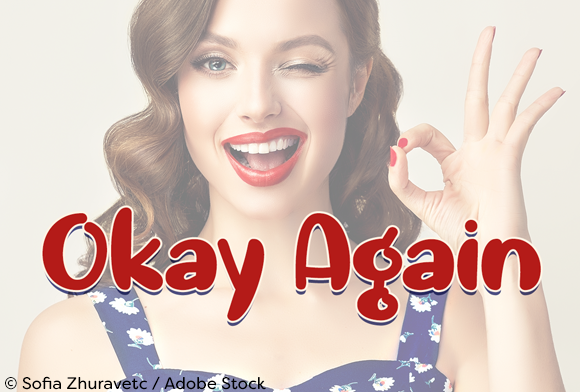
Okay Again isn’t just another handwritten font—it’s a deliberate, slightly off-kilter expression. With uneven baseline alignment, irregular stroke weights, and playful inconsistencies that mimic real pen-on-paper movement, it brings an authentic, human energy to designs. People reach for Okay Again when they want to stand out—not with loudness, but with charm, warmth, and subtle surprise. It works beautifully in branding for creative studios, social media graphics for indie makers, event invites with personality, or blog headers that feel inviting instead of polished.
Assuming It Works Everywhere—Without Testing First
Because Okay Again looks so effortlessly casual, many assume it’ll pair well with any layout or platform. But its strong character means it doesn’t scale gracefully at small sizes—and some web browsers render its variable spacing unpredictably without proper CSS fallbacks. You might love how it looks in your design app, only to find text overlapping or collapsing on mobile, or failing to load entirely in older email clients.
A better approach? Always test Okay Again in context before finalizing. Try it at 16px, 24px, and 48px on both desktop and mobile previews. If you’re using it on the web, embed it via @font-face with a clean sans-serif fallback (like system-ui or Inter) and define line-height and letter-spacing explicitly. For print, export a PDF preview—not just a screen mockup—to verify spacing and kerning hold up under real output conditions.
Mistaking “Handwritten” for “Universal Readability”
Okay Again leans into imperfection—and that’s its strength. But that same quality can trip up readers if used carelessly. Its lowercase g, a, and q have distinctive, looping forms; the z and s share similar curves; and the uppercase I and lowercase l are nearly identical in some weights. In body copy or dense UI labels, those subtleties become barriers—not charm.
Reserve Okay Again for short, high-impact uses: headlines, callouts, logo lockups, or button labels where visual tone matters more than scanning speed. For anything longer than five words—especially instructions, pricing details, or contact info—switch to a legible companion font. Pair it thoughtfully: try a neutral, open-sans typeface like Inter or Manrope for balance. That contrast doesn’t weaken Okay Again—it lets it shine where it belongs.
Overlooking Licensing and Usage Rights
Okay Again is often offered through independent foundries or marketplaces like Creative Market or Adobe Fonts—and licensing varies widely. Some versions allow unlimited web use; others restrict it to personal projects or cap monthly pageviews. One creator assumed their $29 purchase covered all platforms, only to receive a notice from their hosting provider about font-loading violations after launching a client site with heavy traffic.
Before downloading or purchasing, read the license terms—not just the headline. Ask yourself: Will this be embedded in a SaaS dashboard? Used in a client’s printed brochure? Included in a downloadable template sold on Etsy? If yes, confirm whether the license permits commercial redistribution or multi-user access. When in doubt, contact the foundry directly. Many creators respond quickly—and a clear answer now saves time, cost, and awkward revisions later.
Skipping Kerning Adjustments—or Over-Correcting Them
Okay Again ships with thoughtful default kerning, but its organic rhythm means certain letter combinations (like AV, WA, or To) may appear too tight or loose depending on size and background. Beginners sometimes ignore these gaps entirely, while others go overboard—manually adjusting every pair until the rhythm feels forced and unnatural.
Start by enabling optical kerning in your design tool (available in Illustrator, Figma, and Affinity apps). Then zoom in at 200% and scan for obvious collisions or awkward voids—only in the specific context you’re designing for. Adjust sparingly: one or two targeted pairs per headline is usually enough. If you’re setting text in Figma, use the built-in kerning slider rather than manual spacing; it respects the font’s underlying metrics better than adding arbitrary letter-spacing values.
Expecting It to Solve Brand Identity on Its Own
No font—even one as expressive as Okay Again—carries brand meaning by itself. It’s a tool, not a strategy. One small business owner chose Okay Again because it “felt friendly,” then used it across their entire website, packaging, and invoices without adjusting color, weight, or supporting visuals. The result? A disjointed impression—warm in places, confusing in others—because the font wasn’t anchored to consistent voice, imagery, or layout logic.
Instead, treat Okay Again as one element in a broader system. Define when and where it appears (e.g., “Okay Again Bold for H1s only; Inter Regular for all body text”), specify approved color treatments (avoid low-contrast gray-on-white), and pair it with photography or illustration that shares its relaxed confidence. That consistency—not the font alone—is what builds recognition and trust.
What to Check Before You Commit
- File formats: Does the package include WOFF2 (for web) and OTF/TTF (for desktop)? Avoid downloads missing one or the other.
- Weight range: Okay Again typically includes Regular and Bold—but verify if it supports italic or variable axes. Don’t assume.
- Language support: Standard Latin characters are covered, but check if accented letters (é, ñ, ü) or punctuation like em dashes render cleanly in your target language.
- Preview accuracy: Compare the live demo on the foundry’s site with how it renders in your actual software. Differences in hinting or antialiasing happen.
- Update policy: Is the font actively maintained? Some indie releases get minor fixes (kerning tweaks, bug patches); others don’t. A quick GitHub or Discord link in the documentation is a good sign.
Okay Again earns its place when used intentionally—not as decoration, but as deliberate emphasis. It rewards attention to detail, respect for context, and clarity of purpose. Choose it because it fits the feeling you want to convey—not because it’s trending. Then use it where it adds meaning, not noise. That’s how a funky handwritten font becomes unforgettable, not just unusual.