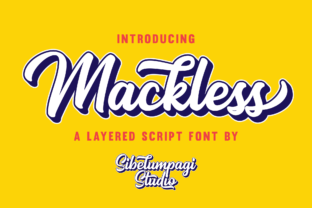
Mackless: A Handwritten Font That Fits Real Creative Workflows
Mackless isn’t just another retro-inspired typeface—it’s a deliberate, expressive tool designed to slot into actual creative work, not just sit in a font menu. Built with the energy of vintage signage and hand-painted lettering, Mackless delivers bold, irregular strokes and playful inconsistencies that feel human—not algorithmic. Its charm lies in its confidence: it doesn’t try to blend in. Instead, it signals intention, personality, and a willingness to stand apart. For professionals who rely on visual clarity and emotional resonance—whether launching a brand, designing a workshop slide deck, or crafting a limited-run zine—Mackless works best when treated as a workflow asset, not just decoration.
Where Mackless Fits in Your Process
Fonts aren’t chosen in isolation. They’re selected at specific decision points: during brand identity development, before finalizing a presentation, while prepping social assets for a product launch, or even mid-way through editing a self-published ebook. Mackless shines most when the goal is differentiation without sacrificing readability—especially in contexts where warmth, approachability, or nostalgic authenticity matter. It’s rarely the *only* font you’ll use, but it often serves as the anchor for voice: the headline that introduces your message, the logo lockup that sets tone, or the pull quote that breaks up dense text.
Think of it like selecting a signature pen—not for every note, but for moments where your hand needs to say something unmistakably *yours*. That makes timing critical. Choosing Mackless too early—before clarifying audience, platform, or hierarchy—can lead to mismatched applications (e.g., using it for body text in a long-form article). Choosing it too late—after layouts are locked—adds friction. The sweet spot is during the “tone-setting” phase: after research and strategy, but before detailed execution begins.
Using Mackless Before a Project Starts
Before opening design software or writing copy, Mackless can help clarify direction. Try sketching rough mockups by hand using the font’s stylistic logic—uneven baselines, exaggerated ascenders, slight slant—as a guide. This isn’t about replicating the font exactly; it’s about internalizing its rhythm so you can make intentional decisions later. For educators building course materials, this might mean drafting a title slide concept that uses Mackless to signal “this isn’t corporate training—it’s collaborative, energetic, grounded in real practice.” For small business owners refining their packaging, it could mean testing how Mackless pairs with a clean sans-serif for ingredient lists—establishing contrast that supports both personality and legibility.
This preparatory use also reveals compatibility constraints early. Mackless performs best against uncluttered backgrounds and with generous spacing. If your intended layout relies heavily on tight grids or layered textures, you’ll need to adjust—either by simplifying the background, increasing line height, or reserving Mackless for isolated elements (like a single hero word or logo mark).
During Execution: Practical Integration Tips
When implementing Mackless in live projects, consistency matters more than quantity. Use it purposefully:
- For branding: Apply it only to primary marks—logos, app icons, or signature campaign headlines—not subheadings or navigation labels.
- In presentations: Reserve it for title slides and key takeaway statements. Pair it with a neutral, highly legible font (like Inter or Open Sans) for body content.
- In digital publishing: Embed it via variable font files if supported, or serve it as a lightweight WOFF2. Avoid using it in long paragraphs—even at larger sizes, its irregularity can fatigue readers over time.
- In print: Test print samples at actual size. Its thick strokes hold up well on matte stock but may fill in slightly on glossy finishes at small sizes.
Also consider fallback behavior. If Mackless fails to load on a website or email client, define a clear stack: Mackless, 'Comic Neue', 'Marker Felt', cursive. This preserves intent without breaking layout. And always check color contrast—its varied stroke weights mean some letters (like lowercase “e” or “a”) may appear lighter than others against certain backgrounds.
After the Project: Long-Term Usability and Quality Control
A font’s value extends beyond launch day. With Mackless, long-term use depends on disciplined application—not just aesthetic appeal. Revisit usage guidelines every 3–6 months, especially if new team members join or platforms change (e.g., migrating from Squarespace to Webflow, or adding dark mode support). Ask: Does Mackless still reflect our current voice? Is it still legible across updated devices? Are we overusing it to compensate for weak messaging?
One practical habit: maintain a “Mackless Usage Log”—a simple shared doc listing every approved instance (e.g., “Homepage H1”, “Newsletter banner”, “Workshop certificate”). Include screenshots, hex colors, and sizing notes. This prevents drift, speeds up onboarding, and surfaces patterns—like realizing it’s being used more often in internal comms than external ones, suggesting a misalignment between internal culture and public positioning.
How Mackless Interacts With Other Tools and People
Mackless doesn’t exist in a vacuum. Its effectiveness multiplies when aligned with other assets and decisions:
- With color systems: Its warmth pairs naturally with earthy tones (terracotta, olive, cream) but also gains unexpected sophistication next to deep indigo or charcoal gray—avoid pairing it with neon brights unless irony or rebellion is the explicit goal.
- With illustration style: It complements hand-drawn icons, imperfect line art, and textured photography—but clashes with hyper-realistic 3D renders or ultra-minimal vector graphics.
- With team workflows: Designers benefit from having Mackless loaded in Figma’s local fonts library; marketers need it pre-installed in Canva Brand Kits; developers require properly hosted files and CSS variables for consistent theming.
- With audience expectations: It resonates strongly with audiences aged 25–45 who associate handwritten aesthetics with authenticity and craft—but may read as “unprofessional” to sectors like finance or legal unless carefully contextualized (e.g., used only in storytelling sections, not compliance footers).
Real-World Workflow Examples
A freelance educator launching an online course: Uses Mackless for the course title and module headers in Notion docs and Loom intros, then switches to a clean sans-serif for lesson transcripts and resource lists. Prepares two versions of each slide—one with Mackless for live sessions (where energy matters), one without for downloadable PDFs (where scanning efficiency matters).
A small-batch candle maker: Applies Mackless only to jar labels (hand-stamped effect) and Instagram story highlights (“New Scents”, “Behind the Wick”). Avoids it on website product grids—opting instead for a crisp, narrow sans-serif there to prioritize quick scanning and comparison.
A nonprofit organizing community workshops: Uses Mackless in printed posters and handouts to signal approachability and local roots—but selects a high-contrast, dyslexia-friendly font for all registration forms and accessibility documents, ensuring inclusivity isn’t compromised for style.
Final Observation: Mackless Rewards Intentionality
Mackless won’t fix unclear messaging. It won’t substitute for thoughtful structure or strong strategy. But when applied with awareness—of context, audience, medium, and purpose—it becomes a quiet accelerator: shortening the gap between idea and impression, reinforcing voice without explanation, and helping people *feel* the intent before they finish reading the first word. That kind of efficiency isn’t measured in keystrokes saved—it’s measured in attention earned, trust built, and ideas remembered.