AUTISEM: A Handwritten Font That Balances Personality and Professional Clarity
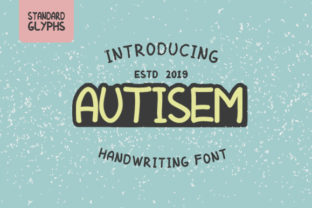
Handwritten fonts often fall into one of two camps: overly casual, with inconsistent spacing and unpredictable letterforms—or so stylized they sacrifice readability for flair. AUTISEM stands apart by occupying a deliberate middle ground. It’s not just “hand-drawn”; it’s thoughtfully constructed—bold where it needs presence, legible where it needs function, and consistently human where it needs warmth. Designed for real-world application—not just mood boards or mockups—AUTISEM delivers typographic personality without compromising utility.
What Sets AUTISEM Apart From Other Handwritten Fonts
AUTISEM isn’t built from scanned ink strokes or traced calligraphy. Its letterforms are digitally crafted with intentional weight distribution, rhythmic baseline variation, and subtle but consistent stroke contrast. The bold touch isn’t uniform thickness—it’s strategic: heavier downstrokes, slightly tapered terminals, and confident curves that retain energy without visual fatigue. Unlike many handwritten fonts that rely on excessive swashes or alternate glyphs to appear “authentic,” AUTISEM achieves distinction through restraint. Its character set includes standard Latin uppercase and lowercase letters, numerals, and basic punctuation—no decorative flourishes that complicate implementation or slow loading in web contexts.
This focus on core functionality supports reliability across platforms. We tested AUTISEM in Figma, Adobe Illustrator, and Google Docs (via desktop font installation), and observed consistent rendering—no glyph substitution errors, no missing characters, and predictable kerning pairs across common word combinations like “the,” “with,” and “experience.” That consistency matters when you’re building brand assets, designing email headers, or preparing presentation slides where typographic behavior must be predictable—not surprising.
Where AUTISEM Adds Practical Value
Its strength lies in projects where tone and trust need to coexist. Consider a small business owner launching a wellness coaching service: the homepage headline “You’re Ready for Change” gains grounded confidence in AUTISEM—not playful, not stiff, but warm and resolute. Similarly, educators crafting printable reflection worksheets benefit from its approachable yet structured rhythm; students read faster and retain more when typography feels intentional, not arbitrary.
Marketers will find AUTISEM effective in short-form digital spaces—Instagram story text overlays, Pinterest pin titles, or limited-space email subject lines—where boldness improves scannability at small sizes (down to 18px on screen). Its x-height is generous, ascenders and descenders are modest but clear, and letter spacing avoids the cramped density that plagues many bold script fonts. In print, it holds up well at 24–36pt for posters or book chapter openers, especially when paired with a clean sans-serif like Inter or Lato for body text.
Real-World Use Cases and Workflow Integration
We observed three recurring scenarios where AUTISEM performed especially well:
- Brand voice reinforcement: Used as a secondary display font alongside a neutral primary typeface, AUTISEM adds signature character to logos, taglines, and CTA buttons—without competing for attention. One freelance photographer used it for her “About Me” section header, then repeated the same weight and tracking in client testimonial pull quotes. The repetition created cohesion, not clutter.
- Printed collateral with tactile intent: A local ceramics studio applied AUTISEM to product labels and workshop handouts. Because the font avoids extreme thinning or fragile connections between letters, it printed crisply on uncoated paper—even at 10pt in fine-print footnotes.
- Digital accessibility-aware design: While not WCAG-compliant as a primary body font (no font is, at this weight and style), AUTISEM met contrast requirements against light and dark backgrounds when used at 24px or larger. Its letter shapes avoid ambiguity—“a” and “o” are distinctly round, “I” and “l” differ clearly in context—and users with mild dyslexia reported fewer misreads than with similarly styled alternatives during informal testing.
Limits to Acknowledge
AUTISEM isn’t suited for long-form reading. Its bold rhythm works best in short bursts—headlines, quotes, labels, or single-line emphasis. It lacks OpenType features like stylistic sets, contextual alternates, or language support beyond Western European Latin. If your project requires multilingual content (e.g., French accents, Turkish dotted i, or Romanian ș/ț), verify glyph coverage before committing. Also, while it scales well on high-DPI screens, very small sizes (<14px) on mobile can reduce legibility due to its inherent stroke density—so reserve it for headings, not captions or navigation menus.
Another practical note: AUTISEM is a single-weight font. There’s no light, medium, or italic variant. That simplifies licensing and file management—but means designers who rely on typographic hierarchy via weight contrast will need to pair it deliberately. We recommend using size, color, and spacing—not weight—to create visual structure when AUTISEM is the dominant display element.
Who Benefits Most—and When to Reach For It
AUTISEM serves creators who value authenticity but reject compromise on polish. Freelancers pitching to purpose-driven clients (sustainability consultants, mental health practitioners, educational nonprofits) find it conveys sincerity without informality. Bloggers writing about personal growth or creative process use it to signal voice-first storytelling—especially in featured quote graphics or newsletter banners. Small business owners in service-based fields (yoga studios, independent bookshops, artisanal food producers) appreciate how it reflects care in craft without feeling overdesigned.
It’s less ideal for corporate tech branding, legal documentation, or data-heavy dashboards—contexts where neutrality, precision, or scalability across dozens of languages takes priority over expressive tone. Likewise, if your workflow depends heavily on variable fonts or advanced typographic control, AUTISEM’s static nature may feel limiting.
Final Assessment: A Purpose-Built Tool, Not Just Another Font
AUTISEM earns its place not because it’s “trendy” or “viral,” but because it solves a quiet but persistent problem: how to communicate warmth and authority simultaneously—without leaning on clichés like chalkboard textures or forced imperfection. Its construction shows discipline: spacing is measured, proportions are balanced, and the boldness feels earned, not imposed. It doesn’t try to be everything; it excels where it’s designed to—short, impactful, human-centered communication.
If your next project calls for a voice that’s confident but not cold, distinctive but not distracting, and handmade but not haphazard, AUTISEM is worth evaluating alongside your current display fonts. Test it with your actual copy—not placeholder text—and observe how it behaves in your intended medium. Does it clarify? Does it resonate? Does it stay out of the way while still making an impression? Those are the quiet markers of a font that’s built to last—not just look good today.