Mountiza: A Whimsical Handwritten Font for Projects That Need Warmth and Personality
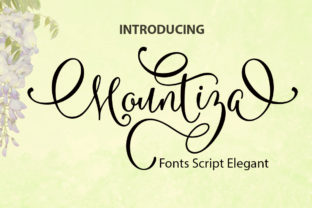
Mountiza stands apart in the landscape of handwritten display fonts—not because it’s the most technically refined or the most widely licensed, but because it carries a distinct, approachable charm that feels both intentional and effortless. It’s not designed to mimic calligraphy with precision, nor does it aim for the bold impact of a poster font. Instead, Mountiza occupies a thoughtful middle ground: legible enough for short headlines and invitations, expressive enough to convey playfulness or sincerity, and consistent enough to maintain visual cohesion across a design.
What Makes Mountiza Distinctive—Beyond “Cute”
At first glance, Mountiza appears light and friendly—its rounded terminals, gentle slant, and uneven baseline evoke the relaxed rhythm of natural handwriting. But what sets it apart is its subtle internal logic. Unlike many handwritten fonts that rely on heavy alternates or random ligatures to simulate authenticity, Mountiza achieves variation through carefully calibrated stroke contrast and spacing. Letters like “a,” “g,” and “y” have open, airy forms; uppercase letters retain soft curves without sacrificing clarity. This balance means Mountiza reads well at medium sizes (24–48pt) on screen and in print—especially where warmth matters more than stark authority.
Its uniqueness isn’t just aesthetic—it’s functional. Mountiza includes standard Latin characters, basic punctuation, and common accented letters (à, é, ñ, ü), making it viable for bilingual projects in English, Spanish, French, and Portuguese. It doesn’t support extended Cyrillic or complex script systems, which is worth noting if your work spans multilingual branding or global publishing.
Where Mountiza Fits Among Handwritten Fonts
Handwritten fonts fall into broad categories: formal script (elegant, connected, often demanding high-resolution output), casual script (looser, less connected, more forgiving), and sketch-style or doodle fonts (intentionally irregular, often used for youthful or artisanal contexts). Mountiza belongs firmly in the casual script group—but with higher legibility and lower visual noise than many peers.
Compared to fonts that lean heavily into irregularity—like those with dramatic swashes, exaggerated ascenders, or unpredictable letter heights—Mountiza offers consistency without sterility. It avoids the “over-processed” look of some auto-generated script fonts, where every alternate feels algorithmically inserted rather than hand-drawn. And unlike minimalist sans-serifs repurposed as “friendly” via rounded corners, Mountiza communicates humanity from its core structure—not through surface-level tweaks.
This makes Mountiza especially effective when you need personality *without* distraction. For example, a small-batch bakery’s packaging benefits from Mountiza’s softness on ingredient labels or seasonal banners—where overly ornate scripts might compete with product photography, and neutral sans-serifs could feel emotionally distant.
Strengths and Practical Tradeoffs
Strengths:
- Memorability with restraint: Its shape is distinctive but not gimmicky—readers recall it without needing to decode it.
- Cross-medium reliability: Performs well on digital interfaces (buttons, hero text), printed stationery (wedding invites, thank-you cards), and even embroidery mockups due to clean outlines.
- Low cognitive load: The rhythm and spacing support quick scanning—useful for event names, short quotes, or social media graphics where attention is fleeting.
- Design flexibility: Pairs naturally with warm neutrals (cream, terracotta, sage), but also holds up against bolder accent colors without clashing.
Tradeoffs to consider:
- Not built for body text: Like most display fonts, Mountiza lacks the x-height, spacing, and character set needed for paragraphs. Using it beyond headlines, pull quotes, or short labels risks fatigue and reduced readability.
- Limited weight range: It’s typically offered in a single regular weight. Designers who rely on bold/medium/thin variations for hierarchy must supplement with a compatible sans-serif or serif.
- Context sensitivity: In highly formal settings—legal documents, academic reports, corporate dashboards—Mountiza may unintentionally signal informality. Its tone is best matched to human-centered goals: connection, invitation, celebration, care.
When Mountiza Is the Right Choice
Mountiza shines where emotional resonance matters as much as information delivery. Think of a children’s book illustrator selecting a font for chapter titles—Mountiza adds narrative warmth without overwhelming illustrations. Or a nonprofit launching a community storytelling campaign: the font gently signals openness and approachability, helping participants feel seen before they even read the first sentence.
It also works well in hybrid design systems. A wellness studio might use Mountiza for class names (“Moonlight Yoga,” “Herb & Honey Workshop”) alongside a clean, open sans-serif (like Inter or Lato) for schedules and contact details. This pairing creates clear visual hierarchy while reinforcing brand values—grounded yet uplifting, professional yet personal.
Another realistic fit: digital products focused on self-expression. A journaling app or creative planning tool might use Mountiza for onboarding headlines or motivational prompts (“What made you smile today?”), where tone supports behavior change more than typographic rigor.
When You Might Choose Something Else
If your project demands scalability across dozens of languages—or requires tight vertical rhythm in dense UI layouts—Mountiza’s scope may be too narrow. Similarly, if your brand voice leans toward sharp wit, technical precision, or avant-garde experimentation, Mountiza’s gentle demeanor could dilute messaging rather than reinforce it.
For long-form editorial work—even within lifestyle or creative publications—Mountiza isn’t practical for body copy. In those cases, evaluating serif or humanist sans options with strong readability metrics (x-height, generous counters, open apertures) becomes essential. Mountiza can still play a supporting role there: as a signature for pull quotes, section dividers, or author bylines.
And if your workflow depends heavily on variable fonts—with continuous weight, width, or optical size adjustments—Mountiza’s static nature means you’ll need complementary typefaces to achieve the same level of responsive control.
Making an Informed Decision
Choosing a font like Mountiza isn’t about finding the “best” option overall—it’s about matching expressive intent with functional requirements. Ask yourself:
- What emotion or impression should this text convey—and does Mountiza align with that, or would another style serve it more directly?
- How much text will appear in this font? If more than a few words per instance, test readability at intended size and medium.
- What other typefaces are already in use? Does Mountiza complement them—or create unintended tension in weight, proportion, or tone?
- Who is the audience? A teen-focused app may welcome Mountiza’s playfulness; a financial advisory service likely won’t.
There’s no universal “right” font—but there are clearer fits. Mountiza earns its place when authenticity, warmth, and memorability are central to the communication goal. It doesn’t try to do everything. Instead, it does one thing very well: invite the reader in—gently, sincerely, and with quiet confidence.
Used thoughtfully, Mountiza becomes more than typography. It becomes part of the message itself.