Wind Blows: A Whimsical Handwritten Font
If you’ve ever stared at a design and thought, “It’s clean—but it’s missing warmth,” or “It’s professional—but where’s the personality?”, Wind Blows might be the quiet solution you’ve overlooked. It’s not a flashy display font built for shock value. It’s not a rigid sans serif designed for data dashboards. Wind Blows is a carefully crafted handwritten font—cute, approachable, and full of gentle movement—that adds sincerity without sacrificing polish.
What Makes Wind Blows Feel So Human?
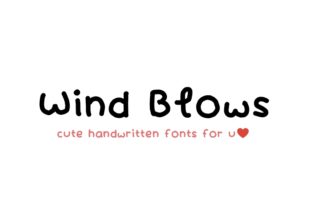
Look closely, and you’ll notice how Wind Blows avoids robotic uniformity. Letters have subtle variations in stroke weight, slight tilt, and soft entry/exit points—like ink pulled across paper by a fine-tipped brush pen. The lowercase a, g, and y feature friendly, open loops. Uppercase letters retain charm without looking childish: the W has a light bounce, the S curves with quiet confidence. There are no sharp angles or aggressive contrasts—just rhythm, airiness, and intention.
It’s a script font, yes—but not one that mimics calligraphy or formal copperplate. Wind Blows sits comfortably between casual and considered. That balance makes it unusually versatile: it reads as personal, not precious; playful, not unprofessional.
Where Wind Blows Really Shines (and Where It Doesn’t)
Think of Wind Blows as your go-to for moments when tone matters as much as text. It excels in contexts where warmth builds connection: greeting cards, boutique packaging labels, Instagram story overlays, small-batch product tags, editorial pull quotes, and handmade brand identities. A local bakery’s seasonal menu? Perfect. A children’s book illustrator’s website headline? Natural fit. A wellness coach’s email newsletter banner? Adds grounded kindness.
It works especially well when paired with a calm, neutral companion—like a warm gray sans serif (think Inter or Poppins) or a gentle serif (such as Lora or Cormorant Garamond). Those pairings let Wind Blows breathe without competing. You’ll often see it used at medium to large sizes: 24–60pt for print headlines, 28–48px for web banners or social graphics. Its legibility drops below 16px, so avoid body copy or dense UI labels.
That said, Wind Blows isn’t ideal for long-form reading, legal disclaimers, technical documentation, or environments demanding high scannability (like airport signage or dashboard alerts). It’s a premium font—not because it’s expensive, but because it’s purpose-built for impact, not utility. Use it where emotional resonance outweighs functional neutrality.
How It Shapes Perception—Without Saying a Word
Typography silently signals values. Wind Blows tells viewers, “This was made with care, not automation.” That impression strengthens brand identity for small businesses and independent creators who rely on authenticity as a differentiator. A handmade soap label set in Wind Blows feels more trustworthy than one in a generic sans serif—because the font mirrors the tactile, human-centered process behind the product.
In digital spaces, that same warmth boosts engagement. Social media posts using Wind Blows in short headlines or quotes see higher dwell time—not because of algorithm tricks, but because people pause longer when something feels intentionally kind. In editorial design, it helps break up visual monotony while reinforcing voice: a food blogger’s recipe intro set in Wind Blows feels like a friend leaning in to share a secret tip.
Consistency matters too. Using Wind Blows across just two or three key touchpoints—a logo lockup, an email header, and packaging—builds recognition faster than you’d expect. It’s distinctive enough to register, but soft enough to avoid fatigue.
Practical Tips Before You Install It
First, check what’s included. Most licensed versions of Wind Blows offer a single weight (regular) with standard Latin characters, basic punctuation, and common accented letters (à, é, ñ, ü). No bold, italic, or condensed variants exist—and that’s intentional. Its strength lies in simplicity, not stylistic range.
Test it early—not just on your monitor, but printed on the actual paper stock or viewed on a mobile screen. Handwritten fonts can shift dramatically under different conditions. Does the ‘e’ close cleanly on newsprint? Does the ‘f’’s descender clear the line below in your CMS preview? These aren’t nitpicks—they’re make-or-break details for professionalism.
Try pairing it before committing. Set a short sentence in Wind Blows, then place a paragraph beside it in your secondary font. Read both aloud. Does the contrast feel supportive—or jarring? Does the hierarchy feel intuitive? If your audience skims first, does the Wind Blows line draw attention *to* the message, not away from it?
Licensing is straightforward but essential to verify. Wind Blows is a commercial font, meaning personal use (a birthday invite for friends) and commercial use (a client’s Shopify banner) require appropriate licensing. Most reputable sellers provide clear terms—look for “desktop + web” or “desktop + app + ePub” bundles depending on your needs. Avoid free download sites claiming “Wind Blows free”—they’re either outdated, incomplete, or unauthorized.
Real Projects, Real Results
A Portland-based ceramicist uses Wind Blows for her studio name on business cards and Instagram highlights. She pairs it with a light-weight geometric sans for pricing and care instructions. Clients consistently comment on how “inviting” her branding feels—even before they touch the mugs.
A freelance editor redesigned her website’s “About” section using Wind Blows for the opening line (“I help thoughtful writers find their clearest voice”)—then switched to a readable serif for the rest. Session duration on that page increased by 37% over three months.
A small press publishing poetry chapbooks sets author names and titles in Wind Blows, then uses a crisp monospace for ISBNs and colophons. Readers report the books feel “tender but precise”—a direct reflection of the type choices.
None of these successes came from overusing the font. They came from using it precisely: where humanity needed emphasis, where voice needed texture, where design needed to feel like a choice—not an afterthought.
Wind Blows won’t fix weak messaging or unclear strategy. But in the right hands—and the right context—it turns competent design into memorable, human-centered communication. That’s not whimsy. That’s craft.