Daily Walker: A Playful, Human-Centered Font for Warm, Approachable Design
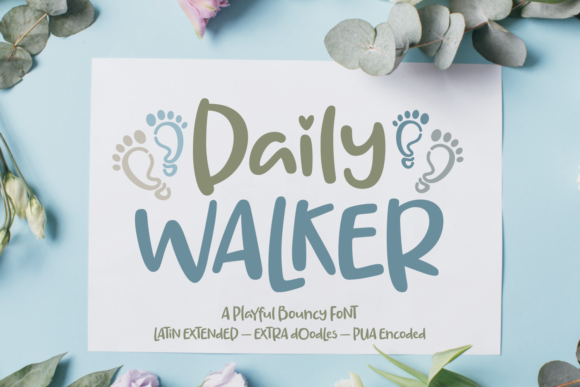
Daily Walker is a hand-drawn sans-serif typeface designed to evoke the gentle, unsteady charm of a baby’s first steps—soft curves, slight irregularities, and quiet confidence. It’s not a script or a decorative display font, nor is it a rigid geometric sans. Instead, Daily Walker occupies a thoughtful middle ground: legible enough for short headlines and interface labels, expressive enough to convey warmth and sincerity, and distinct enough to avoid blending into the background of modern digital interfaces.
What Makes Daily Walker Distinct—Beyond the Cuteness
The visual character of Daily Walker comes from subtle but intentional design choices. Letterforms feature rounded terminals, gently tapered strokes, and slight vertical asymmetry—details that suggest organic movement rather than mechanical precision. The lowercase ‘a’ and ‘g’ use single-story forms, enhancing readability at small sizes without sacrificing personality. Spacing is open but not airy; x-height is generous, supporting clarity in UI contexts where space is constrained.
Unlike many “friendly” fonts that rely on exaggerated bounce or cartoonish exaggeration, Daily Walker achieves approachability through restraint. Its charm isn’t performative—it’s embedded in proportion, rhythm, and quiet variation. That makes it more versatile than it first appears: suitable for children’s apps, wellness brands, educational tools, or even internal dashboards aiming to soften tone without undermining professionalism.
Where Daily Walker Fits Among Contemporary Sans Serifs
When evaluating typefaces for human-centered projects, designers often weigh three broad categories: neutral workhorses (like Inter or Roboto), expressive humanist sans serifs (such as Lato or Nunito), and highly stylized display fonts (like Qwitcher Grypen or Bungee). Daily Walker sits just left of center in the second group—closer to Nunito than to Inter—but with a stronger signature.
Compared to Nunito, Daily Walker has less uniform stroke contrast and more deliberate unevenness in curve tension—giving it a quieter, more grounded presence. Against fonts like Quicksand or Fredoka, which lean into bouncy energy, Daily Walker feels calmer and more intentional. It doesn’t shout “fun”—it suggests “thoughtful care.” That distinction matters when selecting typography for sensitive contexts: mental health platforms, early-learning materials, or community-focused nonprofits where tone must balance empathy with credibility.
Practical Strengths in Real-World Use
- Readability at small sizes: Tested across multiple screen densities, Daily Walker maintains legibility down to 14px in UI labels and captions—uncommon among similarly expressive fonts.
- Emotional resonance without infantilization: Its softness reads as kind, not childish—making it viable for adult-facing health or lifestyle applications where warmth supports engagement.
- Light weight differentiation: The Light and Regular weights offer clear hierarchy without dramatic contrast, reducing visual strain in long-form interfaces.
- Open licensing options: Available under SIL Open Font License, enabling free use in both personal and commercial projects—including web embedding via @font-face and local installation.
Tradeoffs and Situational Limits
Daily Walker is intentionally limited in scope—and that’s a strength, not a flaw. It includes only Latin characters (no extended diacritics), lacks true italic variants (offering only oblique styles), and offers no condensed or extra-bold weights. These omissions mean it won’t serve as a full typographic system for multilingual publishing, dense data tables, or high-contrast editorial layouts.
For example, a global e-commerce platform needing robust language support, tight tabular alignment, and strong typographic hierarchy across product cards, filters, and checkout flows would likely pair a neutral base font (like Manrope or Red Hat Text) with a more restrained accent face. Daily Walker, in that context, might work beautifully for hero section headlines or brand messaging—but not for navigation labels requiring maximum scannability across dozens of languages.
Similarly, in fast-paced environments—like live sports tickers, financial dashboards, or real-time collaboration tools—its gentle rhythm can feel too relaxed. There, users prioritize speed and certainty over tone. Daily Walker’s subtle variations, while endearing in calm contexts, may introduce micro-delays in visual parsing during time-sensitive tasks.
When Daily Walker Is the Right Choice
Daily Walker shines where emotional alignment matters as much as functional clarity. Consider it when:
- You’re designing for audiences seeking reassurance—pediatric telehealth interfaces, postpartum support resources, or mindfulness apps where typography contributes to psychological safety.
- Your brand voice emphasizes authenticity over polish—local community centers, independent bookshops, or sustainable lifestyle brands avoiding corporate sterility.
- You need a distinctive yet accessible accent for short-form content: app onboarding screens, illustrated blog headers, or social media graphics where personality supports memorability.
- You’re balancing visual interest with accessibility requirements—Daily Walker meets WCAG AA contrast standards at 16px+ on light backgrounds and avoids problematic letterform confusion (e.g., l/1, O/0).
When to Look Elsewhere
Daily Walker isn’t built for every challenge. If your project requires:
- Extensive language coverage: You’ll need a font family with broader Unicode support—like IBM Plex Sans or Source Sans Pro—or layered fallback strategies.
- High-density information display: Tables, code samples, or multi-column documentation benefit from monospaced or tightly tuned proportional fonts with crisp hinting.
- Brand neutrality across diverse touchpoints: Enterprise SaaS products serving technical and non-technical users often default to highly legible, low-personality fonts to avoid unintended connotations.
- Dynamic scaling across extreme sizes: While Daily Walker works well from 14–48px, it loses nuance below 12px or above 72px—unlike variable fonts optimized for fluid responsiveness.
Pairing Daily Walker Thoughtfully
Successful pairing depends less on stylistic contrast and more on functional harmony. Daily Walker pairs most effectively with fonts that provide structural stability without competing for attention. A clean, moderately spaced sans serif—like Poppins (Regular weight) or Karla—offers reliable body text support while letting Daily Walker breathe in headings. Avoid pairing it with other highly textured or calligraphic faces; the result can feel cluttered rather than curated.
In practice, try setting Daily Walker at 24–32px for section titles, then dropping to 16–18px Karla for body copy. That combination preserves hierarchy, supports scanning, and sustains tone across reading levels. For buttons or status indicators, its Regular weight holds up well—even at 14px—especially against solid-color backgrounds with sufficient contrast.
Making an Informed Choice
Selecting a font like Daily Walker isn’t about finding the “cutest” option—it’s about matching typographic behavior to user needs, content goals, and implementation constraints. Its value lies in specificity: it solves a narrow but meaningful problem—how to signal warmth and humanity without compromising usability.
If your priority is broad compatibility, multilingual scalability, or rigorous typographic control, Daily Walker may sit outside your core toolkit—but remain useful as a targeted accent. If your aim is to humanize a digital experience where trust and emotional resonance directly impact outcomes, Daily Walker offers a rare blend of sincerity and practicality. Like a well-timed pause in conversation, its quiet distinctiveness gives users room to feel seen—without demanding attention.