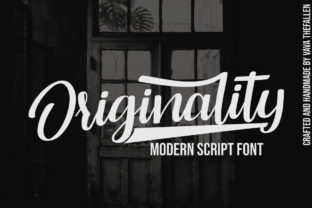
Originality Script: A Handwritten Font for Authentic Yet Modern Design
Originality Script is a contemporary handwritten script font designed to balance classic calligraphic warmth with clean, modern typographic sensibility. It features natural stroke variation, subtle irregularities, and a relaxed rhythm—traits that evoke human handwriting—while maintaining consistent spacing, legibility, and technical polish suitable for digital and print use. Unlike decorative or overly ornate scripts, Originality Script avoids excessive flourishes, prioritizing usability without sacrificing personality.
People often explore fonts like Originality Script when seeking visual distinction in branding, editorial design, packaging, or web interfaces—especially where authenticity, approachability, or artisanal character matters. Its appeal lies not in novelty alone, but in its capacity to support communication goals while reinforcing tone: friendly yet professional, personal yet intentional.
Why Consider Originality Script?
Designers and communicators may find Originality Script compelling for several practical reasons:
- Brand voice alignment: It supports brands emphasizing craftsmanship, creativity, or human-centered values—such as independent boutiques, wellness studios, or artisan food producers.
- Digital readability: With carefully tuned x-height, open counters, and moderate contrast, it remains legible at medium sizes on screens—unlike many highly stylized scripts that blur or lose clarity online.
- Typographic versatility: It includes standard ligatures and alternate characters, allowing subtle customization without requiring advanced OpenType expertise.
- Consistent tone across formats: Because it’s well-hinted and available in web-friendly formats (WOFF2, variable options where supported), it renders predictably across devices and platforms.
Key Benefits—and Realistic Tradeoffs
The primary benefit of Originality Script is its ability to convey warmth and individuality without compromising professionalism. Its letterforms avoid the stiffness of geometric sans-serifs or the formality of traditional serifs, offering a middle ground for projects needing emotional resonance.
However, tradeoffs exist and should inform usage decisions:
- Legibility limits at small sizes: Like most script fonts, Originality Script is not suited for body text or captions under 16px. It works best at headings, logos, pull quotes, or short display lines.
- Language coverage considerations: While supporting Latin-based languages (including accented characters used in French, Spanish, and German), it does not include extended Cyrillic, Greek, or Asian language sets. Projects requiring multilingual support beyond Western European languages will need supplemental typefaces.
- Pairing discipline: Its personality demands thoughtful pairing. Pairing it with overly decorative or similarly high-contrast fonts can create visual competition. Neutral sans-serifs (e.g., Inter, Lato, or Helvetica Neue) or low-contrast serifs (e.g., Merriweather, PT Serif) tend to complement it effectively.
- Licensing scope: Licensing terms vary by vendor and use case—web, desktop, app embedding, or merchandise each carry distinct permissions. Users must verify whether their intended application falls within the purchased license, especially for commercial products or SaaS interfaces.
When Originality Script Fits Well
Originality Script is a strong candidate in contexts where expressive typography reinforces intent—not distracts from it. Examples include:
- A local café’s website headline and menu headers, where friendliness and handmade quality are central to brand identity.
- An illustrated children’s book cover, where the font’s organic flow harmonizes with hand-drawn artwork.
- A boutique skincare brand’s product labels and social media graphics, supporting a narrative of care and natural ingredients.
- A wedding invitation suite, where elegance and personal touch are expected—but formality shouldn’t feel stiff or distant.
In each case, the font functions as part of a broader system: color, imagery, layout, and copy all work together. Originality Script enhances rather than carries the message.
When Alternatives May Be More Appropriate
Originality Script is less suitable—or requires careful adaptation—in certain scenarios:
- High-information density environments: Dashboards, data reports, or instructional documentation benefit from highly legible, neutral typefaces. Here, even modest script elements can reduce scanning efficiency.
- Brands emphasizing precision or authority: Financial services, legal firms, or engineering consultancies typically prioritize clarity and trust signals over stylistic flair. A restrained serif or sans-serif better supports those expectations.
- Projects requiring extensive language support: If your audience spans multiple non-Latin scripts—or if future localization is planned—relying solely on Originality Script limits flexibility. A modular type system with a compatible display font and robust text face is more sustainable.
- Budget-constrained or time-sensitive projects: While not unusually expensive, licensing and implementation (e.g., custom webfont loading, fallback strategies) require slightly more setup than widely available system fonts. Teams with limited design or development bandwidth may prefer simpler alternatives.
Making an Informed Decision
Choosing a script font involves more than aesthetic preference—it reflects how you want audiences to feel and what they need to do. Before committing to Originality Script, ask:
- What is the primary function of the text? If it’s to be read quickly or repeatedly (e.g., navigation labels, form fields), a script is likely inappropriate regardless of style.
- Does the font serve the content—or compete with it? Test it with real copy, at actual sizes and backgrounds. Does hierarchy remain clear? Does emphasis land where intended?
- How much control do you have over surrounding design elements? Originality Script thrives alongside ample whitespace, restrained color palettes, and intentional imagery. Overly busy layouts dilute its impact.
- What are your technical constraints? Confirm file format compatibility, loading performance implications (especially on mobile), and fallback behavior for unsupported characters or browsers.
Finally, consider testing alternatives side-by-side—not just visually, but contextually. Compare Originality Script with other well-regarded handwritten or brush-style fonts (e.g., Pacifico, Caveat, or Quicksand) using identical copy, size, and background. Note differences in rhythm, weight distribution, and perceived tone. The goal isn’t to find the “most beautiful” option, but the one that most reliably supports your communication goals across real-world conditions.
Originality Script occupies a thoughtful niche: neither nostalgic nor trend-driven, but grounded in craft and calibrated for contemporary use. Its value emerges not in isolation, but as one deliberate choice among many—aligned with purpose, audience, and execution discipline.