Speedy Marker: A Bold, Casual Font for Expressive Design
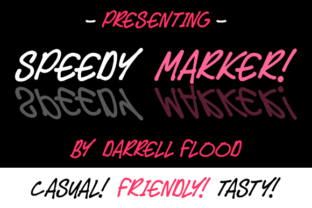
Speedy Marker is a playful, hand-drawn-style typeface designed to evoke the spontaneity of marker pen writing. Its defining traits include uneven stroke widths, subtle tapering, visible texture, and a relaxed rhythm—qualities that give it a bold yet approachable presence. Unlike rigid geometric or highly polished sans serifs, Speedy Marker prioritizes expressive energy over uniform precision. It’s classified as a display font, meaning it’s best suited for short-form, high-impact applications rather than extended body text.
Why Designers Consider Speedy Marker
Designers often explore Speedy Marker when they need to convey creativity, informality, youthfulness, or artistic authenticity. It’s commonly used in contexts where personality matters more than neutrality—such as event posters, social media graphics, packaging for craft or indie brands, or branding for creative studios and educational workshops. Its visual warmth can help humanize digital interfaces or break up monotony in otherwise minimalist layouts.
Users may also be drawn to Speedy Marker for its relative uniqueness among freely available or low-cost display fonts. While many marker-style fonts lean heavily into cartoonish exaggeration or retro cliché, Speedy Marker strikes a middle ground: bold enough to stand out, but restrained enough to retain legibility and versatility across varied uses.
Practical Benefits and Realistic Tradeoffs
One clear benefit of Speedy Marker is its immediate visual impact. Its thick, confident strokes hold up well at larger sizes—even on screens with lower resolution—and pair effectively with simpler, more neutral typefaces (like a clean sans serif) for contrast and hierarchy. It also tends to render consistently across major operating systems and modern browsers when embedded via standard web font protocols.
However, practical tradeoffs exist. Speedy Marker’s irregular letterforms reduce readability in small sizes or dense text blocks. It lacks extensive language support beyond basic Latin characters, limiting use in multilingual projects. Kerning is generally optimized for common English word pairs, but custom combinations—especially those involving punctuation or numerals—may require manual adjustment. Additionally, while the font includes standard weights (often Regular and Bold), it typically does not offer a full variable or extended weight family, which can constrain typographic flexibility in complex design systems.
Another consideration is licensing. Speedy Marker is available under both free and commercial licenses, depending on the source. Users must verify usage rights for their specific context—particularly for client work, merchandise, or SaaS platforms—since some versions restrict embedding or redistribution.
Where Speedy Marker Fits Best
Speedy Marker excels in scenarios where tone and recognition outweigh strict functional neutrality. For example:
- Branding for creative services: A graphic designer’s portfolio site or an illustration studio’s logo lockup benefits from Speedy Marker’s energetic character—reinforcing a hands-on, imaginative identity.
- Marketing assets with short copy: Social media banners, Instagram story templates, or email headers often rely on one or two compelling words; Speedy Marker delivers strong visual emphasis without competing with content.
- Educational or workshop materials: When targeting younger audiences or informal learning environments, its friendly appearance lowers perceived barriers to engagement.
- Print collateral with tactile appeal: Flyers, zines, or handouts gain expressive texture when Speedy Marker is paired with uncoated paper and spot color printing.
When Alternatives May Be More Suitable
Speedy Marker is less appropriate when clarity, scalability, or linguistic breadth are primary requirements. For instance:
- Long-form web content: Headings or pull quotes may work, but using Speedy Marker for paragraphs or navigation labels risks fatigue and reduced comprehension.
- Global or multilingual products: If your audience spans multiple languages—including those using Cyrillic, Greek, or extended diacritics—fonts like Playfair Display or Inter offer broader character sets and more consistent spacing.
- Highly regulated or formal contexts: Government websites, financial dashboards, or medical documentation typically prioritize neutrality and accessibility compliance—traits better served by tested, WCAG-aligned fonts such as Roboto or Open Sans.
- Systems requiring fine-grained typographic control: If you need optical sizing, grade variants, or advanced OpenType features (e.g., stylistic alternates or contextual ligatures), more robust families like Ideal Sans or Futura provide deeper customization options.
Making an Informed Choice
Before committing to Speedy Marker, test it in your actual environment—not just in isolation. Render sample headlines at intended sizes on target devices, and check contrast ratios against background colors to ensure accessibility compliance. If the project involves collaboration, confirm team members have access to the correct file version and license. Also consider how it performs alongside your existing type system: Does it complement or clash with your body font? Does it scale predictably across breakpoints?
Ask yourself whether the font serves a functional role—or simply adds aesthetic flavor. If Speedy Marker strengthens message delivery (e.g., making a call-to-action feel more inviting or a brand voice more distinctive), it’s likely justified. But if its use introduces friction—slower load times, inconsistent rendering, or extra design overhead—it may not justify the tradeoff, even if visually appealing.
Finally, remember that typography is iterative. Speedy Marker may be ideal for one campaign but unsuitable for the next. Keeping a shortlist of alternatives—such as Quicksand, Nunito, or Poppins—allows for quick, evidence-based swaps based on real-world performance and audience response.
In summary, Speedy Marker is a purpose-built tool—not a universal solution. Its value lies in intentionality: using its bold, casual character where it amplifies meaning, rather than applying it broadly for novelty alone. Evaluating it alongside your specific goals, constraints, and users ensures typography supports, rather than obscures, your communication objectives.