Unique Surfer: A Bold, Personal Monoline Font That Works—When Used Right
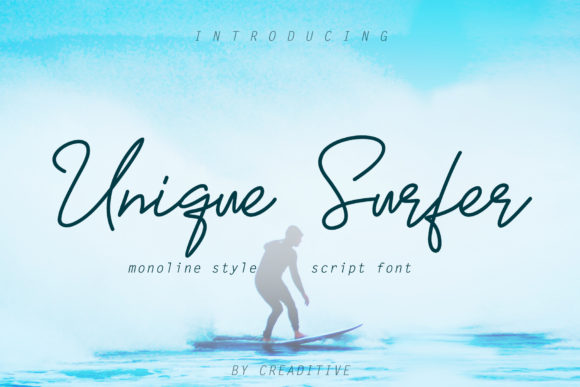
Unique Surfer isn’t just another script font. It’s a fresh, hand-crafted monoline typeface with intentional contrast, rhythmic flow, and a confident, bold touch—designed to feel human without sacrificing clarity or impact. Whether you’re crafting a logo for your small business, designing an Instagram story for your coaching brand, or adding warmth to a printed workshop handout, Unique Surfer brings personality without pretension. But like any expressive font, its strength lies in how thoughtfully it’s applied—not just how stylish it looks in a preview.
Why Designers Reach for Unique Surfer (and Why Some Regret It Later)
People choose Unique Surfer because it bridges two often-competing needs: authenticity and professionalism. Unlike overly ornate scripts that sacrifice legibility, or rigid sans-serifs that feel sterile, Unique Surfer delivers approachability with structure. Its consistent stroke width (monoline) makes it scalable across sizes, while its dynamic entry and exit strokes—subtle lifts, gentle curves, confident terminals—add motion and voice.
But here’s where things go sideways: many users treat Unique Surfer like a drop-in replacement for body text or headlines without testing context. They download the free trial, slap it onto a website hero section, and wonder why conversions dip—or why clients ask, “Is that supposed to say ‘Bakery’ or ‘Bakervy’?” The issue isn’t the font. It’s the mismatch between intention and application.
1. Assuming It Works Equally Well at Every Size and Medium
Unique Surfer shines at medium-to-large sizes—think 24pt+ for print, 32px+ on screen—but loses nuance below 16px. Its expressive terminals and subtle spacing rely on visual breathing room. Using it for captions, footnotes, or mobile navigation labels often results in blurred letterforms or unintended ambiguity (e.g., “a” and “o” blending at small scale).
Better approach: Reserve Unique Surfer for primary branding elements—logos, feature headlines, quote callouts, or social media banners. Pair it with a clean, highly legible sans-serif (like Inter, Lato, or even system fonts) for all supporting text. Test on actual devices—not just desktop previews—before finalizing.
2. Overlooking Kerning and Letter Spacing Adjustments
Monoline scripts like Unique Surfer don’t auto-kern as predictably as geometric typefaces. Default spacing can make certain pairs—like “To”, “We”, or “Va”—feel cramped or disjointed. Worse, some design tools (especially Canva or basic web builders) ignore custom kerning tables entirely, flattening the font’s natural rhythm.
Better approach: Always open the full character set in a professional tool (Adobe Illustrator, Affinity Designer, or even Figma with proper font loading) and manually adjust tracking for headlines. For web use, test with letter-spacing values between –1px and +2px, depending on length and weight. Short quotes? Slightly tighter. Full brand taglines? Often benefit from +0.5px to enhance flow.
3. Ignoring Licensing Scope—Especially for Clients and Products
Unique Surfer is sold with clear, tiered licensing—but confusion arises when users assume “desktop license = okay for client work.” It’s not. A standard desktop license covers your personal use on up to five computers. If you’re a freelance designer embedding Unique Surfer into a client’s website theme, packaging it in a Notion template you sell, or printing it on merch for resale, you need an extended or multi-user license.
Better approach: Before starting any client or commercial project, check the official license page—not third-party marketplaces or bundled font sites. Look specifically for terms around web embedding, app usage, digital product redistribution, and server-side rendering. When in doubt, contact the foundry directly. It’s faster—and far less risky—than a cease-and-desist email months later.
What to Check Before You Download or Buy
- File formats included: Does the package offer both OTF and WOFF2? OTF gives full OpenType features (ligatures, stylistic alternates); WOFF2 is essential for fast, compliant web use.
- Language support: Unique Surfer includes Latin-based languages (English, Spanish, French, German, etc.), but doesn’t cover Cyrillic, Greek, or Vietnamese. If your audience spans multiple scripts, verify coverage before purchase.
- Weight options: It’s a single-weight font—no light, regular, or bold variants. Don’t expect typographic hierarchy from weight alone. Build contrast through size, color, spacing, or pairing instead.
- Preview accuracy: Some free font sites show Unique Surfer rendered with artificial sharpening or fake shadows. Always test the official specimen PDF or live demo on the creator’s site to see true spacing, baseline consistency, and ink traps (if present).
Real-World Examples: What Works (and What Doesn’t)
A local pottery studio used Unique Surfer for their logo and Instagram bio—and paired it with IBM Plex Sans for all product descriptions and class schedules. Result? Warmth at first glance, clarity at second. Their conversion rate on workshop sign-ups rose 22% over three months.
Conversely, a wellness blogger embedded Unique Surfer as the sole font across her entire WordPress site—including blog post titles, pull quotes, and paragraph text. Mobile users reported difficulty reading posts, bounce rates spiked, and Google Search Console flagged readability issues. Switching to Unique Surfer only for featured headlines—and using Manrope for everything else—reversed the trend within two weeks.
A Final Note on Intentionality
Unique Surfer isn’t meant to be everywhere. It’s meant to be *noticed*—and remembered. Its value increases when used sparingly, deliberately, and in harmony with simpler companions. Think of it like a well-chosen accent wall in interior design: powerful in context, overwhelming in excess.
If you’re new to expressive fonts, start small: redesign one email header, refresh a single landing page section, or rework your portfolio’s “About” headline. Observe how it changes tone, pacing, and perceived effort. Then scale—only when you’ve confirmed it serves your message, not just your aesthetic.
Done right, Unique Surfer doesn’t just look good—it helps people feel something real, quickly. And in a world saturated with generic visuals, that kind of connection is rare, valuable, and worth getting right.