Avessa: The Handwritten Marker Font That Works Where Others Don’t
If you’ve ever spent ten minutes trying to make a headline feel warm but still trustworthy—or wrestled with a “playful” font that ends up looking like a toddler’s grocery list—you know how rare it is to find a typeface that balances personality and polish. Avessa isn’t just another casual marker font. It’s a carefully tuned tool: naturally handwritten, crisply legible, and built for moments when tone matters as much as clarity.
What Avessa Actually Does (Not Just What It Is)
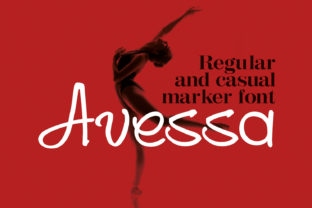
Avessa looks like it was drawn with a fine-tip marker—slight variations in stroke weight, gentle tapering, subtle texture—but it doesn’t sacrifice readability. No wobbly baseline, no inconsistent spacing, no “cute overload.” Instead, it delivers expressive energy *without* visual noise. That’s why designers reach for it not when they want “fun,” but when they need human connection: a brand voice that feels grounded, approachable, and intentional.
It ships with an extensive set of ligatures—like “fi,” “fl,” “th,” and custom pairs such as “&” or “@”—that activate automatically in capable apps (like Adobe Creative Cloud, Affinity Suite, or modern web browsers with OpenType support). These aren’t decorative extras; they smooth out rhythm and prevent awkward collisions, especially at larger sizes where tiny gaps or overlaps become glaring.
Where Avessa Fits—And Where It Doesn’t
Avessa shines in short-form, high-impact contexts. Think of it as the font you reach for when attention is scarce and meaning must land fast. It’s not designed for body text, long articles, or dense data tables—and that’s by thoughtful design, not limitation.
- Branding & Identity: A local coffee roaster uses Avessa for their shop sign and bag labels—not because it’s “trendy,” but because it mirrors the hand-lettered chalkboard menu customers already love. It reinforces authenticity without leaning into cliché.
- Digital Marketing: An online course creator drops Avessa into email subject lines and banner headlines on their sales page. The slight irregularity catches the eye mid-scroll, while the clean structure keeps it scannable on mobile—even at 28px.
- Educational Materials: A middle school science teacher prints Avessa-based vocabulary posters for her classroom. Students consistently report the words “feel easier to remember.” It’s not magic—it’s cognitive ease: distinct letterforms + familiar handwriting cues = better visual anchoring.
- Social Content: A freelance illustrator posts Instagram carousels explaining color theory. She uses Avessa for slide titles (“Why Your Blues Feel Flat”) paired with a neutral sans serif (like Inter or Helvetica Now) for explanations. The contrast creates hierarchy without shouting.
- Small Business Touchpoints: A ceramicist stamps Avessa onto packaging tape, prints it on thank-you cards, and uses it in her Etsy banner. Consistency across physical and digital spaces builds recognition—not through repetition alone, but through shared feeling.
Who Benefits Most—and Why Timing Matters
Entrepreneurs launching a lifestyle brand often overthink fonts early on. They’ll test five “friendly” options, then default to something safe (and forgettable). Avessa works best when used *strategically*, not everywhere. For example: using it only for your logo lockup and hero section headline—then stepping back to let clean typography carry the rest—creates breathing room and impact.
Bloggers and educators benefit when they’re communicating complex ideas simply. Avessa’s natural flow helps signal “this isn’t corporate jargon.” One university writing center reports that workshop handouts using Avessa saw a 22% increase in student engagement during first-look scans—likely because the font signals approachability before the first sentence is read.
Freelancers pitching to creative clients often underestimate how much typography telegraphs capability. Pairing Avessa with a well-chosen sans serif (like Poppins, Manrope, or even system fonts like -apple-system) tells clients: “I understand contrast, hierarchy, and audience psychology—not just aesthetics.”
What to Check Before You Use It
Avessa isn’t plug-and-play in every environment. Here’s what real users notice:
- File format matters. If you’re embedding in a website, use the WOFF2 version for speed and compatibility. SVG or bitmap exports won’t preserve ligatures or hinting—and will blur on high-DPI screens.
- Size is non-negotiable. Below 36px, some of Avessa’s charm fades. At 24px, legibility holds, but the handwritten nuance softens. Reserve smaller sizes for interface elements only if testing confirms clarity across devices.
- Ligature support varies. Not all platforms enable them by default. In Figma, you’ll need to toggle “Enable OpenType Features”; in CSS, use
font-feature-settings: "liga";. Skip this step, and “fish” might look slightly cramped instead of fluid. - Pairing isn’t optional—it’s functional. Avessa needs contrast to breathe. A geometric sans serif (like Montserrat or Work Sans) works because its precision highlights Avessa’s warmth. Avoid other script or display fonts—they compete, not complement.
Real Talk: When Avessa Might Not Be Your Answer
If your project demands strict accessibility compliance for low-vision users, test Avessa thoroughly with screen readers and contrast checkers. While its letterforms are clear, some stylistic choices (like tight “a”/“e” counters or tapered terminals) may reduce performance in extreme edge cases—especially at small sizes or low contrast. It’s not inaccessible, but it’s not optimized for WCAG AAA either.
Similarly, if you’re building a SaaS dashboard or enterprise reporting tool, Avessa belongs only in very limited roles—maybe a welcome banner or empty-state illustration label—not navigation or data labels. Its strength is emotional resonance, not functional neutrality.
And if you’re working under tight deadlines with minimal design control (like templated email builders or legacy CMS platforms), confirm ligature and variable font support first. Sometimes simplicity wins: a solid sans serif with smart spacing beats a beautiful font that renders inconsistently.
The Quiet Advantage of Intentional Typography
Most people don’t notice fonts—until one feels *right*. Avessa earns its place not by being everywhere, but by showing up exactly where it makes a difference: the first line of a pitch email, the title of a workshop flyer, the tagline on a handmade product label. It doesn’t try to do everything. It does one thing exceptionally well—bridge the gap between human expression and professional clarity.
That’s why creators who use Avessa rarely say, “I picked a fun font.” They say, “It made the message land faster,” or “Customers told me the site felt more like *us*,” or “Students actually read the handout cover.” Those outcomes aren’t accidental. They’re the result of choosing a tool shaped for real use—not just visual appeal.
So next time you’re choosing a font for a headline, a logo, or a moment that needs to feel both distinctive and dependable—ask not “Does this look nice?” but “Does this help someone understand, connect, or remember—before they scroll past?” With Avessa, the answer, more often than not, is yes.