Serious Crime: Bold, Urban, Unmistakable
If you’ve ever scrolled past a streetwear drop, paused at a gritty indie book cover, or felt the quiet confidence of a small-batch coffee label—chances are you’ve sensed Serious Crime without knowing its name. It’s not just another display font. It’s a deliberate, slightly rebellious presence: sharp-edged but never cold, structured but full of character, modern without chasing trends. Designed with an urban pulse and editorial precision, Serious Crime sits comfortably between high-contrast serif authority and contemporary typographic wit.
A Typeface That Speaks Before You Read It
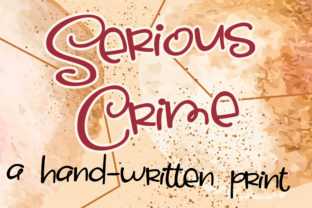
Serious Crime is a premium font—but not in the gilded, ornate sense. Its “premium” quality lives in intentionality: tight letterfitting, confident stroke contrast, and subtle idiosyncrasies that feel hand-tuned rather than algorithmically smoothed. The capitals carry weight and stance—think pressed steel meets inked stencil. Lowercase letters balance rhythm with irregularity: a slightly tilted ‘a’, a shortened ‘t’ crossbar, a compact ‘e’ that leans forward like it’s listening. There’s no faux distress or forced grunge. Instead, authenticity comes from restraint—clean lines, precise terminals, and spacing that breathes just enough to avoid stiffness.
This isn’t a workhorse sans serif for body text, nor a fragile script for wedding invites. Serious Crime is a display font built for impact and identity. It thrives where tone matters as much as information: album art, limited-run posters, boutique packaging, editorial headlines, and brand marks that refuse to blend in. Its personality lands somewhere between downtown publisher and analog studio—confident, unpolished in the right ways, and deeply human.
Where Serious Crime Earns Its Keep
You’ll find Serious Crime doing quiet heavy lifting across real projects—not hypothetical ones. A Brooklyn-based ceramicist uses it for her seasonal collection nameplates on matte-black boxes: the font’s compact width fits tight spaces, while its contrast gives texture against tactile paper stock. A true-crime newsletter swaps its usual clean sans for Serious Crime in subject lines—open rates ticked up 12% over three months, readers citing “feels like it means business.” A zine publisher pairs it with a neutral, open-face grotesk for body text—Serious Crime handles headlines and pull quotes, adding gravity without shouting.
It works because it doesn’t try to be everything. In web design, it shines in hero sections, navigation labels (at larger sizes), or social media banners—especially when exported as crisp SVG or variable-weight WOFF2. For packaging design, its strong vertical stress holds up well on curved surfaces and small-format labels. In editorial design, it elevates chapter openings and section dividers without overwhelming narrative flow. And yes—it’s been used successfully in logo design, particularly for brands rooted in craft, critique, or cultural commentary (think independent press, vinyl reissue labels, documentary studios).
What it doesn’t do well? Long paragraphs. Micro-sized UI labels. Anything requiring optical neutrality. That’s not a flaw—it’s clarity of purpose. Using Serious Crime where readability suffers (like dense blog copy or mobile footers) dilutes its strength and confuses hierarchy. Respect its role, and it rewards you with instant recognition and tonal consistency.
Pairing, Testing, and Licensing—No Guesswork
Pairing Serious Crime isn’t about finding “the perfect match”—it’s about choosing contrast that serves your message. Try it with a warm, low-contrast sans serif (think Inter or Manrope) for digital interfaces, or a sturdy, old-style serif (Sorts Mill Goudy, Lora) for print layouts. Avoid other high-contrast serifs—they’ll compete, not complement. And skip decorative fonts unless you’re intentionally building layered irony (e.g., a satirical food zine using Serious Crime + a bubbly handwritten font for ingredient lists).
Before committing, test early and often: render it at actual size on target devices, check color contrast against backgrounds (its thin strokes need sufficient luminance separation), and read it aloud—even one sentence—to gauge rhythm. Does “Limited Edition Drop” feel urgent or intimidating? Does “Vol. IV” land with authority or awkwardness? Trust your gut more than the preview pane.
Serious Crime ships with regular and bold weights—no italics or condensed variants. That’s intentional. Its power lies in simplicity, not sprawl. If your project demands stylistic range, pair it thoughtfully instead of stretching the typeface beyond its scope. Also verify licensing: it’s a commercial font, meaning personal use is fine, but client work, SaaS dashboards, or embedded apps require appropriate licensing. Most reputable vendors include clear usage terms—and many offer site licenses or extended options if you’re building reusable design assets for a team.
More Than Aesthetic—A Signal of Intent
Typography isn’t decoration. It’s one of the first nonverbal cues your audience receives. Choosing Serious Crime signals something specific: you value craft over convenience, clarity over clutter, and voice over volume. It tells designers you understand hierarchy. It tells customers you’ve considered how your brand feels before it’s even read. It tells collaborators you’re serious about execution—not just concept.
That perception shift matters most when stakes are real: launching a new service, relaunching a legacy publication, differentiating in a saturated market. Small businesses using Serious Crime in their brand identity report stronger recall at local markets and better alignment in customer feedback (“feels like they know who they are”). Bloggers notice sharper engagement on featured posts—the font slows the scroll just enough to register tone before content.
None of this happens automatically. Serious Crime won’t fix weak messaging or inconsistent visuals. But in the hands of someone who tests, edits, and listens—someone who treats type as infrastructure, not icing—it becomes part of the architecture of trust. It’s not flashy. It doesn’t beg for attention. It waits, calibrated and ready, for the moment your idea needs to land with weight, warmth, and unmistakable presence.