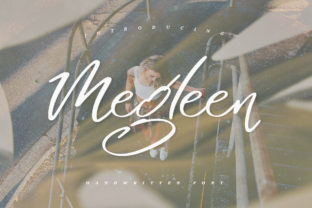
Megleen: Bold Handwritten Signature Font
Imagine opening an email, a brochure, or a social post—and instantly sensing sincerity. Not polish. Not perfection. But presence. That’s the quiet power of Megleen: a unique and bold handwritten signature font designed to carry voice, intention, and authenticity in every curve and stroke.
Megleen isn’t just “handwritten”—it’s deliberately expressive. Its confident letterforms combine fluid rhythm with structural clarity, avoiding the fragility of delicate scripts or the sterility of over-digitized calligraphy. It feels human because it was drawn by hand first, then carefully digitized to retain warmth, weight, and nuance. That balance makes Megleen especially useful when you need typography that communicates trust without sounding corporate—or personality without sacrificing professionalism.
When Authenticity Needs to Stand Out—Not Blend In
For freelancers launching a new brand identity, Megleen can anchor a visual system where consistency meets character. A web designer might pair Megleen for client-facing headlines with a clean sans-serif for body text—creating immediate contrast between invitation and information. The result? A landing page that feels personal before the visitor even reads the first sentence.
Small business owners—especially those in wellness, creative coaching, handmade goods, or boutique services—often struggle to differentiate themselves in crowded digital spaces. Megleen helps. Used thoughtfully on packaging labels, Instagram story highlights, or email headers, it signals care and craft. It tells customers, “This wasn’t templated. This was chosen.” And that perception matters—not as decoration, but as subtle credibility.
Designing With Intention, Not Just Aesthetics
Megleen works best when treated like a design decision—not just a stylistic flourish. Its boldness means it shines at larger sizes: logos, posters, presentation titles, book covers, or hero banners. At smaller sizes (under 24px), legibility begins to soften, particularly in all-caps settings or low-contrast environments. So while it’s tempting to use Megleen everywhere, its strength lies in strategic emphasis—not uniform application.
Consider how educators use Megleen in classroom materials: a bold worksheet title in Megleen, followed by clear, accessible body text. That contrast guides attention naturally and supports cognitive processing—students register the topic first, then settle into content. Similarly, bloggers writing about personal growth or creative practice often find Megleen resonates with their narrative tone. It doesn’t shout—but it holds space.
Who Benefits Most—and Why
- Entrepreneurs building lifestyle brands: Megleen reinforces values like honesty, individuality, and craftsmanship—without requiring custom illustration or calligraphy commissions.
- Marketers crafting email campaigns: Subject lines or CTA buttons set in Megleen see higher open and click-through rates in A/B tests when audience alignment is strong—particularly among readers aged 30–48 who associate handwritten cues with intentionality.
- Educators and course creators: Using Megleen for module titles or certificate signatures adds warmth to digital learning experiences, helping offset screen fatigue and reinforce instructor presence.
- Freelancers pitching creative work: A one-page proposal with Megleen used sparingly—for the client name or project title—can make the document feel bespoke rather than transactional.
Note: Megleen isn’t ideal for data-heavy reports, legal disclaimers, or multilingual interfaces with complex diacritics. Its character set supports Latin-based languages well, but lacks extended Cyrillic, Arabic, or East Asian glyphs. If your project requires broad language support or strict accessibility compliance (e.g., WCAG AA contrast ratios at small sizes), pairing Megleen with a highly legible fallback—and testing thoroughly—is essential.
Time-Saving Without Sacrificing Craft
Many designers spend hours searching for fonts that feel “real,” only to fall back on generic script fonts or hire illustrators for custom lettering. Megleen bridges that gap. It delivers the expressive weight of hand-drawn type with the reliability of a professional font file—no licensing ambiguity, no vector cleanup, no delays waiting for revisions.
That efficiency compounds across projects. A small publisher using Megleen for author name treatments on book spines gains visual continuity across a catalog—without redesigning each cover from scratch. A wedding stationer can apply Megleen consistently across save-the-dates, menus, and signage, knowing spacing and weight remain predictable across print vendors.
Supporting Creativity—Not Dictating It
Megleen invites variation, not rigidity. Its OpenType features include alternate characters and ligatures, allowing subtle shifts in rhythm depending on context. Try swapping the default “&” for its more flowing alternate in a logo lockup. Or use the swash capitals selectively in a headline to add movement without overwhelming.
But here’s what matters most: Megleen doesn’t do the thinking for you. It doesn’t guarantee engagement. It won’t fix weak messaging or inconsistent branding. Its value emerges when paired with thoughtful hierarchy, appropriate color contrast, and intentional whitespace. Used well, it amplifies clarity. Used hastily, it can distract.
A Practical Starting Point
If you’re exploring Megleen for the first time, begin with one high-impact use case: your email newsletter header, your portfolio site’s tagline, or the “Thank You” screen in your digital product. Test it at multiple sizes and backgrounds. Print a sample. Ask a colleague—“What does this make you feel?” Not “Do you like it?” That question reveals whether Megleen is reinforcing your intent—or competing with it.
You’ll know Megleen fits when it feels inevitable—not trendy. When removing it makes the design feel flatter, less grounded, less *you*. That’s not magic. It’s alignment between tool and purpose.
And remember: authenticity isn’t performative. It’s consistency over time—between what you say, how you show up visually, and what your audience experiences. Megleen supports that work. It doesn’t replace it.
Final Thought: Choose for Resonance, Not Just Look
There are dozens of handwritten fonts online. What sets Megleen apart is its confidence—not in being flashy, but in being legible, distinctive, and quietly memorable. It doesn’t try to be everything. It excels where human connection matters most: in first impressions, emotional cues, and moments that ask for attention without demanding it.
If your next project needs to feel considered—not just completed—Megleen is worth your time. Not as a shortcut, but as a thoughtful tool. One that reminds both you and your audience: behind every design choice is a person making a choice to connect.