Rosianne: Bold Handwritten Elegance
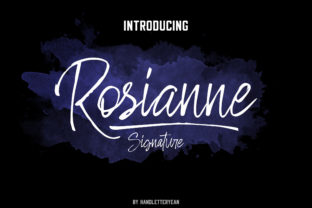
If you’ve ever stared at a blank layout wondering how to make your headline feel both personal and polished, Rosianne might be the quiet solution you’ve overlooked. It’s not another trendy script that fades after three Instagram posts. Rosianne is a premium font—handwritten in spirit but refined in execution—with an elegant, classic sensibility that holds weight without shouting. The strokes have confident contrast: thick downstrokes anchor each letter, while delicate upstrokes lift the rhythm. There’s subtle irregularity—just enough to feel human—but no distracting flourishes or forced quirkiness. That balance makes Rosianne work where many handwritten fonts stumble: in real projects, with real audiences, under real deadlines.
Where Rosianne Earns Its Place
Rosianne shines as a display font—not for body copy, but for moments that need intention and warmth. Think logo design for a boutique bakery, a wedding invitation suite, or the hero text on a small-batch skincare brand’s homepage. It pairs especially well with clean sans serif fonts (like Inter, Poppins, or Montserrat) for contrast that feels intentional, not accidental. In editorial design, it elevates section headers in a digital magazine or adds character to pull quotes in a long-form blog post. For crafters and hobbyists, Rosianne brings authenticity to handmade product tags, greeting cards, or embroidery patterns—without looking like a generic “craft font” from a free bundle.
In packaging design, Rosianne adds tactile appeal. A jar of small-batch honey, a linen tea towel, or a ceramic mug—each benefits from its gentle authority. On social media graphics, it stands out in feeds saturated with over-edited sans serifs and ultra-thin scripts. Unlike many script fonts, Rosianne maintains legibility even at smaller sizes on mobile—especially when used sparingly and with generous spacing. It doesn’t try to be everything; it excels where personality matters more than neutrality.
What Rosianne Communicates—Without Saying a Word
Typography shapes perception faster than most people realize. Rosianne signals care, craftsmanship, and quiet confidence. It doesn’t scream “luxury” with gold foil and excessive kerning—it implies it through rhythm and restraint. That has tangible impact on brand perception. A café using Rosianne for its chalkboard menu and tote bags feels grounded and intentional, not trend-chasing. A wellness coach pairing Rosianne with a warm neutral palette conveys approachability *and* professionalism—two qualities often at odds in script fonts.
Readability here isn’t about scanning paragraphs—it’s about instant recognition and emotional resonance. Rosianne’s letterforms are distinct enough to avoid confusion (no ambiguous a/o or l/i collisions), and its x-height sits comfortably for screen and print use. For visual hierarchy, it works best as a top-level accent: headlines, logos, short quotes, or monogrammed initials. Drop it into a dense paragraph, and it disrupts flow. Use it for a single line above a clean sans serif subhead, and it commands attention while inviting trust.
Practical Tips Before You Install
Start by asking: *Is this the voice my audience expects—or needs—to hear?* Rosianne suits brands and creators who value authenticity over polish-for-polish’s-sake. It’s less effective for tech startups, law firms, or finance newsletters aiming for razor-sharp neutrality. But for a children’s book illustrator launching a Patreon, a florist designing seasonal lookbooks, or a podcast host branding their newsletter—it fits like a well-worn glove.
Check what styles are included. Most Rosianne licenses offer at least one weight (often Regular), sometimes with alternate characters or ligatures. Look for true italics—not slanted versions—and test how the font handles common punctuation, ampersands, and numerals. If your project requires bold emphasis, pair Rosianne with a strong, legible sans serif rather than forcing a faux-bold version.
Test pairings early. Try Rosianne alongside two or three sans serifs in your actual layout—not just in a font menu. Adjust tracking (letter spacing) manually; Rosianne often benefits from +20–+40 units in display settings to let the forms breathe. Avoid tight leading underneath—it needs room to land gracefully next to supporting text.
Licensing & Real-World Use
Rosianne is a commercial font, meaning it’s built for professional use—but only if properly licensed. Free downloads from unofficial sites often lack OpenType features, contain malware, or violate usage terms. Legitimate sources include the foundry’s own site or trusted marketplaces like Creative Market or MyFonts. Licenses typically cover desktop use (design software), web use (via @font-face or third-party hosting), and app embedding—each with different limits. A small business owner using Rosianne on their Shopify store, business cards, and Instagram highlights needs a license that includes both desktop and web permissions. A blogger embedding it in a WordPress theme should verify web font hosting compatibility and pageview allowances.
Don’t assume “personal use only” covers a side hustle—even if you’re not yet charging clients. If your portfolio site uses Rosianne to showcase freelance work, or your Etsy shop banner features it prominently, that’s commercial use. When in doubt, opt for the standard commercial license. It’s a small investment that protects your time, reputation, and legal standing—far more valuable than saving $29 upfront.
A Final Note on Intention
Rosianne won’t fix weak messaging or inconsistent branding. But in the hands of someone who understands timing, spacing, and audience context, it becomes a quiet amplifier. It’s the difference between a headline that blends in and one that lingers—not because it’s loud, but because it feels unmistakably *meant* to be there. Whether you’re sketching a logo on paper or fine-tuning CSS for a landing page, Rosianne rewards thoughtful application. It asks for space, clarity, and purpose—and gives back elegance, warmth, and distinction.