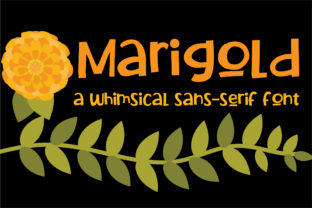
Marigold: A Whimsical Yet Strategic Choice for Thoughtful Typography
Marigold isn’t just another sans serif font—it’s a deliberate design decision with quiet intentionality. With its soft, open letterforms and that distinctive, occasional underline, Marigold balances playfulness and precision. It doesn’t shout; it invites. And in today’s saturated visual landscape—where clarity, authenticity, and tonal consistency drive engagement—fonts like Marigold offer more than aesthetic appeal. They serve as subtle but meaningful levers for positioning, communication, and brand coherence.
Why Marigold Fits Real-World Strategy (Not Just Aesthetics)
Typography is rarely neutral. Every typeface carries connotations: authority or approachability, tradition or innovation, rigor or warmth. Marigold leans into the latter trio—approability, innovation, warmth—but does so with enough structural integrity to avoid feeling frivolous. That occasional underline isn’t decorative whimsy alone; it functions as a gentle visual anchor—drawing attention without aggression, reinforcing emphasis without heaviness. For entrepreneurs launching a values-driven service, educators designing inclusive learning materials, or freelancers building a personal brand rooted in empathy and creativity, Marigold supports tone before a single word is read.
Contrast this with default system fonts—or even widely used “friendly” sans serifs like Nunito or Quicksand. Those often aim for universal neutrality. Marigold opts instead for *distinctive familiarity*: recognizable enough to feel accessible, unique enough to signal intention. That distinction matters when you’re competing for attention in crowded feeds, email inboxes, or onboarding flows.
Where Marigold Delivers Measurable Value
Strategic typography pays off where attention, comprehension, and emotional resonance intersect. Here’s where Marigold consistently contributes:
- Brand voice alignment: If your messaging emphasizes care, curiosity, or human-centered thinking—Marigold reinforces it without needing explanation. A wellness coach’s newsletter header in Marigold feels intuitively aligned; the same font in a corporate compliance document would raise eyebrows (appropriately).
- Digital readability with personality: Its generous x-height and open counters improve legibility at small sizes—critical for mobile interfaces, dashboard labels, or captioned social content—while retaining character. Unlike ultra-thin or tightly spaced alternatives, Marigold breathes without sacrificing density.
- Visual hierarchy with subtlety: That signature underline works exceptionally well for interactive elements (e.g., subtle hover states on navigation links) or light emphasis in body copy—offering contrast without bolding, which can disrupt reading rhythm.
- Complementarity with serif pairings: Marigold’s sister font, Mariblock, offers a thoughtful serif counterpart—same proportions, shared spacing logic, and intentional contrast. Using them together (e.g., Marigold for UI labels and headings, Mariblock for long-form articles or testimonials) creates typographic harmony that signals craft, not coincidence.
When—and When Not—to Choose Marigold
Intentional use starts with honest assessment of context and goals. Marigold excels in environments where warmth, clarity, and approachability are strategic assets—not just stylistic preferences.
Use Marigold when:
- You’re designing for audiences who value empathy over authority—think mental health platforms, educational tools, creative workshops, or community-driven SaaS products.
- Your content prioritizes scannability and emotional tone over formal gravitas—email subject lines, onboarding tooltips, illustrated blog headers, or product feature cards.
- You need a primary font that scales gracefully across devices and supports accessibility best practices (e.g., sufficient contrast, responsive sizing, clear glyph differentiation).
- You’re building a cohesive visual language and already using Mariblock—or plan to introduce it later for print collateral, reports, or long-form storytelling.
Avoid defaulting to Marigold when:
- The goal is maximum neutrality or institutional trust—legal disclosures, financial dashboards, or enterprise technical documentation benefit from more restrained, high-legibility options like Inter or Source Sans Pro.
- Your brand voice centers on power, austerity, or disruption—Marigold’s gentleness may dilute impact where sharp contrast or assertive clarity is required.
- You haven’t audited your existing type system. Introducing Marigold without adjusting line heights, letter spacing, or weight usage can create visual inconsistency—even if the font itself is well-chosen.
Practical Integration: Beyond Copy-Paste
Adopting Marigold thoughtfully means moving past installation to integration. Consider these grounded steps:
Start with one high-impact touchpoint. Don’t overhaul everything at once. Try Marigold in your email newsletter header, your pricing page feature list, or your Notion workspace theme. Measure how it affects engagement metrics (open rates, time-on-page, scroll depth) alongside qualitative feedback (“Did this feel welcoming? Clear? Too casual?”).
Define usage rules—not just weights. Decide in advance: Will the underline appear only on interactive elements? Only in H3s? Never in body text? Document those constraints. Consistency builds recognition; randomness erodes trust.
Test pairing rigorously. Marigold + Mariblock is a strong foundation, but test how they behave at 14px vs. 24px, in dark mode, and with your primary color palette. Does the underline disappear against certain backgrounds? Does Mariblock’s serif feel jarring next to Marigold’s rounded terminals in tight layouts? Adjust tracking, weight contrast, or fallback stacks accordingly.
Consider operational implications. If you’re a team of three using Figma, ensure Marigold is loaded in your shared library with clear layer naming conventions. If you’re a solo blogger using WordPress, verify webfont loading performance—Marigold’s variable axis support helps, but unused axes add bloat. Prioritize what you actually use.
Risks of Using Marigold Without Strategy
The biggest risk isn’t that Marigold looks “wrong”—it’s that it looks *unintentional*. When typography lacks rationale, audiences subconsciously question coherence: Is this brand confident in its voice? Does it understand its audience? Is attention being spent meaningfully?
Using Marigold everywhere—buttons, footers, data tables, error messages—flattens hierarchy and blurs purpose. It also risks tonal mismatch: a playful underline under a “Payment Failed” message undermines seriousness. Similarly, applying Marigold without adjusting line height or paragraph spacing can hurt readability in dense content, counteracting its strengths.
Worse, adopting Marigold solely because it’s “trendy” or “cute” ignores its functional DNA. It wasn’t designed to be background noise. It’s designed to quietly shape perception—so using it passively forfeits that leverage.
Long-Term Thinking: From Font to Foundation
Marigold gains compound value when treated as part of a broader design system—not an isolated asset. Over time, teams that document its role (“Marigold = friendly interface layer; Mariblock = narrative layer”) build shared understanding faster. Clients notice consistency across touchpoints. Learners absorb information more readily when typographic cues reinforce structure.
That long-term payoff depends on grounding Marigold in outcomes—not aesthetics alone. Ask regularly: Does this use of Marigold make the user’s next step clearer? Does it reduce cognitive load? Does it reflect who we serve—not just who we wish to be?
For creators iterating on digital products, educators refining course materials, or small business owners redesigning their website—Marigold offers a rare balance: expressive enough to stand out, disciplined enough to scale. Its occasional underline isn’t just a flourish. It’s a reminder: emphasis matters, but so does restraint. Clarity requires both.
So choose Marigold not because it’s charming—but because its charm serves your goals. Because its openness supports comprehension. Because its relationship with Mariblock enables evolution—not reinvention. Typography, at its best, is strategy made visible. Marigold makes that visibility kind, clear, and quietly confident.