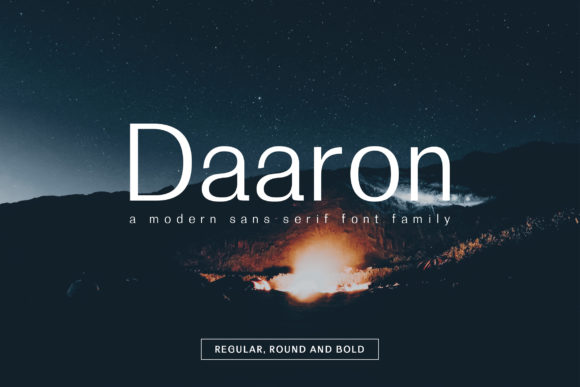
Daaron Family: A Modern, Minimalist Font That Fits Your Workflow
Daaron Family isn’t just another font release—it’s a design asset built for clarity, consistency, and quiet confidence. With three carefully crafted weights—Regular, Round, and Bold—Daaron balances geometric precision with subtle humanist warmth. It doesn’t shout. It communicates. And that makes it unusually effective in real-world workflows where legibility, tone, and efficiency matter more than ornamentation.
Where Daaron Fits in Your Design Process
Fonts aren’t isolated choices. They’re part of a chain: research → strategy → layout → content → delivery → feedback → iteration. Daaron Family slots cleanly into the *layout* and *content* phases—but its influence extends earlier and later. Before you open Figma or InDesign, knowing Daaron is available helps shape your visual hierarchy decisions. Its distinct Round weight, for example, signals approachability without sacrificing structure—ideal for onboarding screens or educational materials. The Bold version delivers emphasis without visual aggression, making it reliable for callouts, headings, or data labels in dashboards.
During implementation, Daaron’s consistent x-height and open counters reduce eye strain across long-form text—whether that’s a blog post, internal training doc, or product spec sheet. After launch, its neutrality supports brand evolution: it doesn’t lock you into a trend, so it scales with your voice as your audience or offerings grow.
Using Daaron Before the Project Begins
Preparation matters. If you’re planning a rebrand, launching a course, or building a new SaaS landing page, include Daaron in your typography audit early. Ask: Does this font support our tone? Can it carry both headlines and body copy without switching families? Does it render well across devices and platforms we use—like Notion, Webflow, or Canva?
Daaron Family is web-optimized and includes WOFF2 variants, so it integrates smoothly into modern front-end stacks. If you’re using Google Fonts (or self-hosting), test loading performance alongside your other assets—Daaron’s lightweight files mean minimal impact on Core Web Vitals. For print projects, its tight but breathable letter spacing ensures crisp output at any size, from business cards to large-format signage.
How Daaron Works With Other Tools and Systems
Daaron doesn’t exist in isolation—and it shouldn’t need to. It pairs predictably with common design systems and development environments:
- Figma & Adobe XD: Install the desktop fonts or use variable-compatible web versions via plugins. The Round weight works especially well in UI components where softness improves perceived usability—think toggle labels, empty states, or microcopy.
- Web Development: Define Daaron in your CSS @font-face rules or via a CDN. Use font-weight values 400 (Regular), 500 (Round), and 700 (Bold) to match its intended behavior. Avoid faux-bold or italic rendering—the family includes true italic variants where appropriate.
- Content Platforms: In WordPress or Ghost, upload Daaron as a custom font or use a plugin that supports local hosting. Pair it with clean, semantic heading structures (
h1–h6) to reinforce hierarchy without extra styling. - Print & PDF Workflows: Embed Daaron in Illustrator, InDesign, or Affinity Publisher files. Its OpenType features—including standard ligatures and case-sensitive forms—activate automatically when enabled, improving typographic refinement in formal documents or reports.
Importantly, Daaron avoids stylistic conflict. It doesn’t compete with bold photography, complex illustrations, or dense data visualizations. Instead, it recedes just enough to let those elements breathe—while still asserting presence when needed.
Practical Implementation Tips for Real Workflows
Here’s how professionals actually use Daaron—not in theory, but in daily execution:
For Educators & Course Creators
Use Regular for slide body text and handouts; Round for interactive quiz instructions or reflection prompts. The subtle friendliness lowers cognitive load during learning. Keep line height at 1.5–1.6 and max line length under 75 characters for optimal readability in digital lessons.
For Marketers & Small Business Owners
Deploy Bold for email subject lines and CTA buttons—its weight carries through inbox previews and mobile truncation. Reserve Round for testimonials or value propositions where warmth builds trust. Maintain consistent sizing: 18px/28px for headings, 16px/24px for body—no arbitrary scaling.
For Developers & Product Teams
Define Daaron as your primary UI font stack in design tokens. Set up reusable text styles in Figma tied directly to code variables (e.g., --font-heading, --font-body). This eliminates guesswork during handoff and reduces QA time spent fixing inconsistent typography.
For Freelancers & Agencies
Include Daaron in your brand guidelines template—not as an afterthought, but as a defined system. Specify usage rules: “Round is for user-facing microcopy only,” “Bold is reserved for primary actions and section headers.” Clear constraints speed up client approvals and reduce revision rounds.
Long-Term Usability and Quality Control
A font’s value compounds over time—if it holds up. Daaron’s limited but intentional weight range prevents decision fatigue while supporting meaningful contrast. Unlike expansive super-families with 12+ weights, Daaron asks you to make deliberate choices: what role does each weight play in your communication? That discipline improves consistency across touchpoints.
Test Daaron in real conditions: view it on low-DPI screens, in ambient light, at 80% zoom, and with system-level accessibility settings like bold text or increased contrast enabled. Its even stroke distribution and generous counters help it remain legible where other minimalist fonts falter.
Version control matters too. If you’re managing Daaron across multiple projects, store it in a shared team library with clear naming (e.g., daaron-regular-v2.1.woff2) and document fallbacks (e.g., "Daaron", -apple-system, BlinkMacSystemFont, "Segoe UI", sans-serif). That prevents drift when collaborators update or replace files.
Integrating Daaron Smoothly Into Your Routine
You don’t need to overhaul everything to benefit from Daaron. Start small:
- Pick one recurring asset—a newsletter template, a pitch deck, or a Notion workspace—and swap in Daaron for headings and body text.
- Run a side-by-side comparison: same content, same layout, two fonts. Note where Daaron improves scanning speed, perceived professionalism, or emotional resonance.
- Document your observations: Which weight feels most natural for subheadings? Where does Round soften tone without sacrificing clarity? Use those notes to guide broader adoption.
Over time, Daaron becomes less of a “choice” and more of a reflex—like reaching for a trusted pen or opening your default project folder. That’s when it stops being a tool and starts functioning as infrastructure: silent, reliable, and always ready.
Its strength lies not in novelty, but in restraint. Daaron Family doesn’t ask you to adapt your process around it. Instead, it adapts—cleanly, consistently—to how you already work.