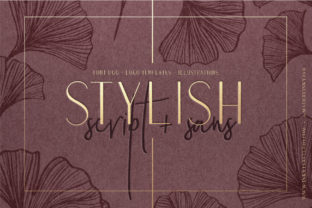
Stylish Duo: A Sophisticated Font Pair That Just Works
If you've ever spent 20 minutes toggling between font combinations—only to land back where you started—you’ll appreciate how rare it is to find a duo that feels intentional, balanced, and instantly polished. Stylish Duo isn’t just another pairing; it’s a thoughtfully engineered set of two complementary typefaces designed to work in harmony, not compete for attention.
At its core, Stylish Duo consists of a refined serif and a clean, slightly warm sans-serif—each crafted with optical consistency, even spacing, and subtle personality. Neither face overpowers the other. The serif carries quiet authority (think editorial elegance or premium packaging), while the sans brings approachability and modern clarity (ideal for UI labels, callouts, or responsive headlines). Together, they create visual rhythm without requiring typographic gymnastics.
Why This Duo Stands Out in Real Projects
Most font pairings rely on contrast—but contrast alone doesn’t guarantee cohesion. Stylish Duo solves this by sharing underlying design DNA: matching x-heights, consistent stroke modulation, and harmonized proportions. That means when you set a headline in the serif and body copy in the sans, line heights align naturally. Margins breathe evenly. Hierarchy emerges without manual kerning tweaks or line-height overrides.
This isn’t theoretical. Designers using Stylish Duo report cutting layout time by 30–40% on brochure templates, landing pages, and pitch decks. Why? Because the fonts behave predictably across sizes—from 12pt captions to 96pt hero text—and render cleanly on both Retina displays and older Android devices.
Where Stylish Duo Fits Naturally
You don’t need a branding agency retainer to benefit from Stylish Duo. Its versatility shines across everyday contexts:
- Small business owners use it for cohesive social graphics and email headers—pairing the serif for “Handcrafted Since 2012” and the sans for “Join Our Newsletter” creates instant credibility without looking corporate.
- Educators and course creators apply it in slide decks: serif for section titles (“Understanding Cognitive Load”), sans for bullet points and definitions—improving readability during live sessions and recorded playback.
- Bloggers and newsletter writers deploy it for scannable long-form content—serif for article titles and pull quotes, sans for body text and CTA buttons—keeping tone warm but authoritative.
- Freelance designers embed it in Figma kits and Notion brand systems, knowing clients can swap copy without breaking alignment or hierarchy.
It also performs well in constrained environments: legal disclaimers, product spec sheets, and bilingual layouts. The sans-serif maintains legibility at small sizes, while the serif adds gravitas to short statements—no extra weights or alternates needed.
What Makes the Typography Feel Effortless
Three practical traits set Stylish Duo apart:
- True optical sizing: The serif includes dedicated caption and display cuts—not just scaled versions. That means your 10pt footnote retains crisp serifs, while your 48pt banner avoids spindly thinness.
- Smart punctuation: Curly quotes, em dashes, and ligatures activate automatically in supported apps (Figma, Adobe CC, modern browsers). No manual swaps needed for professional polish.
- OpenType features built-in: Small caps, old-style figures, and discretionary ligatures are accessible via standard font menus—not buried behind code or plugin dependencies.
These aren’t “nice-to-haves.” They’re time-savers that prevent last-minute fixes before client handoff or print deadlines.
Real-World Considerations Before You Commit
Stylish Duo works best when you respect its intent—not as a Swiss Army knife, but as a focused tool. It’s not ideal for high-contrast editorial spreads needing extreme weight variation (e.g., ultra-bold headlines over hairline subheads), nor for interfaces demanding 12+ weights and widths. If your project needs that level of typographic granularity, pair it with a robust variable font instead.
Licensing is straightforward: one perpetual license covers desktop, web, and app use for up to five users—no monthly subscriptions or seat-based renewals. Web fonts include WOFF2 support and optional self-hosting, giving you control over loading performance and GDPR compliance.
Also worth noting: Stylish Duo includes localized glyphs for Western, Central, and Eastern European languages, plus basic Vietnamese support. It doesn’t cover Arabic, Hebrew, or CJK scripts—but that’s transparently documented, not hidden behind vague “multilingual” claims.
A Few Practical Tips for Getting Started
You don’t need to overhaul your entire workflow to test Stylish Duo. Try these low-effort entry points:
- Replace your current heading + body pair in one live landing page. Compare bounce rate and time-on-page after 7 days—many users see measurable engagement lifts simply from improved text density and flow.
- In Notion or Obsidian, assign the serif to “H1” and the sans to “Body”—then write a single weekly reflection. Notice how much less mental energy it takes to format headings versus wrestling with inconsistent spacing.
- When designing a simple Canva social post, use the serif for your brand tagline and the sans for the value prop. Skip the “font search” step entirely.
And if you’re collaborating with non-designers—clients, teachers, or team members who rarely touch typography—Stylish Duo reduces friction. There’s no debate about “which sans goes with which serif.” There’s just one answer that reliably works.
Final Thought: It’s About Confidence, Not Complexity
Great typography shouldn’t demand expertise to use well. Stylish Duo delivers sophistication without prerequisites. It won’t fix weak messaging or poor information architecture—but it will make strong ideas easier to absorb, more pleasant to interact with, and more memorable to revisit.
That’s the quiet power of a truly considered font duo: not flash, but function. Not novelty, but reliability. When your tools fade into the background and let your content lead, that’s when design does its best work.