Funky Psycho: A Kooky Handwritten Font
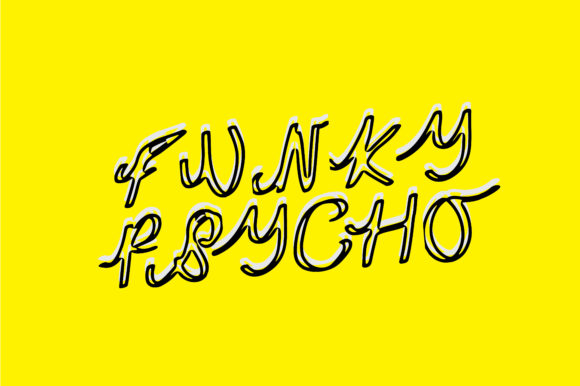
If you’ve ever wanted a typeface that doesn’t take itself seriously—but still delivers real design impact—Funky Psycho is worth your attention. It’s an outlined handwritten font, meaning each letter has a clean, open stroke with visible inner space, giving it that playful, slightly unhinged charm. Think of it as the visual equivalent of a wink and a grin: quirky, confident, and unmistakably human.
What Makes Funky Psycho Stand Out?
Unlike tightly kerned sans-serifs or polished script fonts, Funky Psycho leans into imperfection. Its letters vary subtly in height and angle, mimicking natural handwriting—but with bold, deliberate outlines that ensure legibility even at larger sizes. There’s no forced elegance here. Instead, you get energy, movement, and personality baked right into the glyphs.
The outline style gives designers flexibility: fill it with color, leave it transparent over imagery, or layer it with shadows and gradients for extra dimension. Because it’s not overly dense or decorative, it avoids visual clutter—even when used alongside busier design elements.
Who Benefits Most from This Font?
Beginners love Funky Psycho because it’s intuitive to use—no need to master ligatures or alternate characters to get great results. Just type, scale, and go. For marketers and small business owners, it adds instant character to social media graphics, event posters, or limited-edition product labels without requiring custom illustration.
Educators might use it for classroom banners or student project titles to spark joy and reduce visual fatigue. Freelancers and bloggers often reach for it when designing email headers, podcast cover art, or workshop slides—anything where warmth and approachability matter more than formality.
Real-World Uses That Work Well
- Instagram Stories & Reels: Overlay short, punchy text like “YES!” or “Gone Wild” in Funky Psycho to match upbeat, spontaneous content.
- Local Business Signage: A café owner could use it on a chalkboard-style menu board or seasonal window decal—giving off friendly, neighborhood-vibe energy.
- DIY Craft Projects: Print it on stickers, tote bags, or greeting cards; its bold outline holds up well on textured paper or fabric transfers.
- Educational Handouts: Use it sparingly for section headers in student worksheets—it draws attention without overwhelming young readers.
- Podcast Branding: Pair it with a simple sans-serif body font for logo variations that feel both memorable and grounded.
It’s not meant for long paragraphs or fine print—its strength lies in moments of emphasis. That’s actually a feature, not a limitation. Good typography knows when to step forward and when to fade back.
How It Fits Into Your Design Toolkit
Think of Funky Psycho as your “personality booster.” You wouldn’t use it for a legal contract or a corporate annual report—and that’s okay. Its value comes from contrast: pairing it with clean, neutral fonts creates balance and hierarchy. Try it with Montserrat, Inter, or even Georgia for surprising yet harmonious combinations.
Because it’s outlined—not filled—it also scales beautifully across formats. Whether you’re exporting for web (as a WOFF2), preparing a PDF presentation, or cutting vinyl for signage, the shape stays crisp. No fuzzy edges, no lost detail.
Things to Keep in Mind Before Using It
First, consider your audience. While many people find its kooky tone refreshing, some contexts call for restraint. A healthcare clinic’s patient intake form probably isn’t the best place for Funky Psycho, but their community wellness event poster? Absolutely.
Second, test readability early. At very small sizes (under 16px on screen or 8pt in print), the interior space in the outlines can start to close up visually. Stick to headlines, titles, buttons, and short phrases where it shines.
Third, check licensing. Some versions are free for personal use only—so if you're using it in client work, merchandise, or digital products, make sure you have the appropriate commercial license. Reputable font marketplaces usually clarify this upfront.
A Friendly Nudge Toward Playful Typography
Typography doesn’t always have to communicate authority or precision. Sometimes, it’s about signaling openness, creativity, or lighthearted confidence. Funky Psycho does exactly that—without demanding special software skills or hours of tweaking.
You don’t need to be a designer to appreciate how a well-chosen font changes the mood of a message. One word set in Funky Psycho can shift something from “meh” to “I want to click,” “I want to buy,” or “I want to share this.” That subtle psychological nudge matters—especially in crowded digital spaces.
And because it’s handwritten in spirit but structured enough for consistency, it bridges the gap between authenticity and professionalism. It says, “We made this with care—and maybe a little mischief.”
Getting Started Is Simple
Download the font file (usually .OTF or .TTF), install it on your computer, and try it in tools you already use—Canva, Google Slides, Adobe Express, Figma, or even Microsoft Word. Start small: replace one heading on a flyer, add it to a Pinterest pin caption, or drop it into a Canva template.
Notice how it changes the rhythm of the layout. Does it feel bolder? Friendlier? More unexpected? Trust those instincts. Great type choices often come from gut reactions—not just theory.
Remember: fonts aren’t just about letters. They’re about tone, timing, and texture. With Funky Psycho, you’re not just choosing a typeface—you’re choosing a vibe.