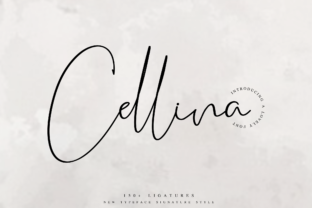
Cellina: Bold, Beautiful, and Uniquely Yours
Cellina isn’t just another display font—it’s a confident voice on the page. Designed with expressive curves, balanced contrast, and subtle calligraphic warmth, Cellina stands out without shouting. Its uppercase letters carry presence; its lowercase forms flow with quiet rhythm. Whether you’re crafting a boutique logo, designing an Instagram story, or laying out a workshop handout, Cellina brings personality that feels intentional—not decorative for decoration’s sake.
Why Designers Reach for Cellina First
It’s rare to find a font that balances distinction with readability—especially at smaller sizes or in dynamic layouts. Cellina achieves this through thoughtful proportions: generous x-height, open counters, and consistent stroke modulation. That means it works as well on a mobile screen headline as it does engraved on a ceramic mug. Unlike overly stylized fonts that sacrifice function, Cellina supports clarity while adding character.
Its versatility shines in pairing. Try Cellina with a clean, neutral sans-serif like Inter or Lato for body text—this contrast creates visual hierarchy without tension. For print projects like event posters or zines, pair it with a textured serif or even a restrained monospace for unexpected but grounded harmony.
Creative Uses Across Real Projects
Think beyond headlines. Cellina thrives where tone and identity matter:
- Small business branding: A local florist used Cellina for their shop sign and packaging labels—soft curves echoing petal shapes, while the bold weight held up beautifully on matte kraft paper.
- Educational materials: An online course creator applied Cellina to section headers in their PDF workbooks. Learners reported improved engagement—“It felt inviting, not intimidating,” one shared.
- Social content: Bloggers use Cellina in Canva templates for quote graphics. Because its letterforms have natural asymmetry (notice the gentle tilt in the ‘e’ or the extended tail of the ‘y’), static text feels alive—even without animation.
- Printed ephemera: Wedding stationers choose Cellina for invitation suites when couples want elegance with approachability—not stiff formality, not casual whimsy.
What ties these uses together isn’t just aesthetics—it’s intentionality. Cellina doesn’t force a mood; it amplifies the one you’ve already chosen.
Adapting Cellina for Your Audience and Platform
Audience context changes how Cellina performs—and how you should use it.
For educators and trainers: Use Cellina sparingly—but purposefully. A single line of Cellina at the top of a slide signals “this is the core idea.” Avoid setting full paragraphs in it; instead, let it frame key takeaways or learning objectives. This keeps cognitive load low while reinforcing structure.
For freelancers and small studios: Build consistency by limiting Cellina to two roles across your brand: e.g., your logo + email subject lines. That repetition builds recognition without overuse. When exporting social banners or pitch decks, embed Cellina as outlined text only if you can’t guarantee font loading—otherwise, stick to web-safe fallbacks in supporting copy.
For bloggers and content creators: Cellina works best when contrasted—not crowded. On websites, apply it only to H1s and featured pull quotes. In newsletters, reserve it for preview text above the fold. Its strength lies in scarcity: one strong moment beats five diluted ones.
Keeping It Clear and Cohesive
Even expressive fonts need boundaries. Here’s how to keep Cellina effective:
- Limit weight variation. Cellina includes Regular and Bold—but avoid mixing both in one layout unless there’s clear typographic hierarchy (e.g., Bold for title, Regular for subtitle). Too many weights dilute impact.
- Respect spacing. Its generous letterforms need room to breathe. Increase tracking slightly (+20–40 units) in all-caps settings. In body applications, maintain at least 1.4 line height when used at 18px or larger.
- Test legibility early. View Cellina at 75% zoom on a phone screen. If the ‘a’, ‘e’, or ‘s’ blur together, reduce size or switch to a simpler typeface for that context.
- Stay true to your voice. If your brand voice is direct and pragmatic, Cellina’s warmth shouldn’t soften your message—it should humanize it. Pair it with crisp photography and concise copy, not dreamy filters or vague language.
Going Beyond the Obvious: Unexpected Applications
Cellina excels where personality meets practicality—so consider less common uses:
- Interactive prototypes: Use Cellina in Figma or Adobe XD mockups to signal “this is the final voice”—helping stakeholders align faster on tone before development begins.
- Physical signage for pop-ups: Laser-cut acrylic or vinyl lettering in Cellina holds up beautifully under varied lighting. Its rounded terminals resist chipping better than sharp, high-contrast alternatives.
- Custom icons or glyphs: Some designers extract individual letters (like the elegant ‘C’ or flowing ‘g’) and adapt them as minimalist icons for apps or dashboards—blending typography and interface design.
- Accessible emphasis: When paired with proper color contrast (at least 4.5:1 against background), Cellina’s distinct shapes help users with dyslexia or low vision distinguish words more easily than tightly spaced, uniform fonts.
None of these require special tools—just attention to how people actually see, read, and respond.
A Final Thought: Tools Serve Ideas, Not the Other Way Around
Cellina won’t fix unclear messaging or inconsistent branding. But when your idea is solid—and your audience matters—Cellina helps that idea land with sincerity and strength. It’s not about making things “prettier.” It’s about making them feel *recognized*: seen, considered, and respectfully expressed.
So before you reach for the next trending font, ask: Does this support what I’m trying to say—or distract from it? With Cellina, the answer is often yes—provided you give it space, structure, and purpose. Start small: try it on one project header this week. Adjust tracking. Compare it beside your current go-to. Notice how it shifts the tone—not dramatically, but meaningfully.
That’s where real creative confidence begins: not in choosing the boldest option, but the one that fits like it was made for this moment, this message, this person.