Brush Hours: The Playful, Purposeful Font That Adds Personality to Any Project
Fonts do more than spell out words—they set the tone, shape perception, and quietly influence how your audience feels before they’ve even read a single sentence. Among today’s growing library of expressive typefaces, Brush Hours stands out not just for its visual charm, but for its surprising versatility. It’s not a one-trick script or a fleeting trend font. It’s a carefully balanced blend of spontaneity and structure—designed to feel hand-drawn yet consistently legible, energetic yet never chaotic.
What Makes Brush Hours Feel So Fresh?
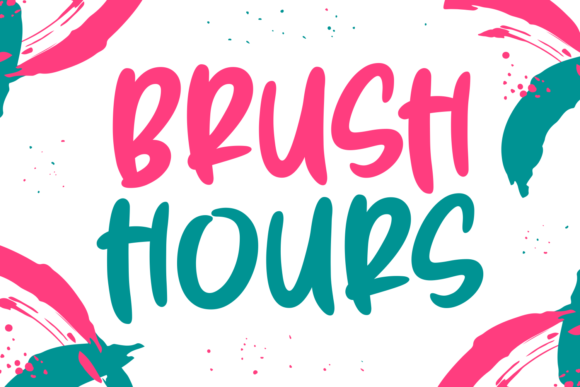
At first glance, Brush Hours looks like it was sketched with a soft-tipped brush pen—slight tapering on strokes, gentle irregularities in line weight, and subtle texture baked right into the letterforms. But unlike many brush-style fonts that sacrifice clarity for flair, Brush Hours maintains generous x-heights, open counters, and thoughtful spacing. That means it reads well at medium sizes—not just as a headline flourish, but as part of a cohesive typographic system.
The rhythm is key. Letters flow into one another with natural entry and exit strokes—but without forced ligatures or automatic connections. This gives designers full control: use it connected for a fluid, handwritten vibe, or space it out for a breezy, modern contrast. Its lowercase ‘a’, ‘g’, and ‘y’ feature relaxed, friendly shapes—not overly stylized, not sterile. And the uppercase letters? They hold presence without shouting. You get personality *and* professionalism in the same family.
Where Brush Hours Fits Naturally (and Where It Surprises)
Some fonts are built for specific contexts—branding, signage, editorial layouts—and others live across many. Brush Hours belongs to the latter group. Its sweet spot lies where warmth meets intentionality. Think of it as the go-to when you want to signal approachability without losing credibility.
- Food & beverage branding: A craft coffee shop menu, a small-batch jam label, or a weekend farmers’ market booth—all benefit from Brush Hours’ organic energy. It whispers “made with care,” not “mass-produced.”
- Creative portfolios & personal websites: Illustrators, photographers, and lettering artists often choose Brush Hours for headlines and section titles. It complements imagery without competing—and adds a layer of human authenticity that sans-serifs sometimes lack.
- Social media graphics & digital campaigns: On Instagram carousels or email headers, Brush Hours draws attention in crowded feeds. Its texture holds up well on screens, especially when paired with clean body text (like Inter, Lato, or even Georgia).
- Event invitations & stationery: Weddings, gallery openings, pop-up workshops—any occasion where you want elegance with ease. It avoids cliché calligraphy while still feeling special and intentional.
What’s less obvious—but increasingly common—is its use in UX interfaces. Not for body copy, of course. But for playful microcopy (“Let’s get started!”, “You’re all set ✨”, “Tap to explore”) or branded onboarding flows, Brush Hours adds a moment of delight without compromising usability.
Practical Tips for Using Brush Hours Well
Like any expressive typeface, Brush Hours shines brightest when used with purpose—not just because it looks cool. Here’s how to make it work for you, not against you:
- Respect hierarchy. Use it for headlines, quotes, or short labels—not paragraphs. Let it lead; don’t let it drown. Pair it with a neutral, highly readable sans-serif for supporting text. Avoid pairing it with other decorative fonts unless you’re aiming for deliberate, curated contrast.
- Watch your color contrast. Because of its textured stroke, Brush Hours performs best with solid, high-contrast colors—deep navy on cream, charcoal on white, or rich terracotta on off-white. Avoid light gray on white or pastel-on-pastel—it loses definition quickly.
- Test at real sizes. What looks charming at 72pt can blur or tighten at 18pt. Preview your design at actual usage size—on both desktop and mobile. If letters start to merge or lose shape, scale up slightly or increase letter-spacing by 2–5 units.
- Consider weight options. While Brush Hours currently offers a primary weight with stylistic alternates (like swash capitals or dotted variants), smart use of those alternates adds nuance. Try swapping a standard ‘A’ for a swash version in a logo lockup—or using the dotted ‘i’ in a tagline for a subtle wink of personality.
Why Designers Are Choosing Brush Hours Over Similar Fonts
There’s no shortage of brush-inspired typefaces. So why does Brush Hours keep showing up in award-winning sites, indie packaging, and thoughtful brand systems? Three reasons stand out:
- It doesn’t overpromise. Unlike fonts that mimic messy handwriting or exaggerated calligraphy, Brush Hours acknowledges its digital roots—it’s designed *for* screens and print, not as a nostalgic imitation. That makes it feel current, not costumey.
- It scales with intention. Many brush fonts fall apart below 24pt. Brush Hours remains legible down to ~16pt in headings—making it viable for responsive layouts where space is tight but voice matters.
- It invites collaboration. Because it’s not aggressively idiosyncratic, clients and stakeholders tend to respond well to it. It feels familiar enough to trust, distinctive enough to remember. That reduces revision cycles and builds alignment faster.
Real-World Inspiration: How Teams Are Applying Brush Hours Today
A Portland-based ceramics studio uses Brush Hours for product name tags and workshop banners—paired with a crisp, geometric sans for ingredient lists and class descriptions. The contrast mirrors their ethos: handmade process, thoughtful precision.
An online learning platform for creative freelancers chose Brush Hours for course titles and instructor bios. It softens the tech-heavy interface and reinforces their human-first teaching philosophy—without undermining the authority of their curriculum.
A children’s book illustrator integrated Brush Hours into chapter title spreads—not as the main narrative font, but as a rhythmic, joyful punctuation between illustrated scenes. Readers (and parents) subconsciously associate it with moments of play and transition.
Getting Started With Brush Hours
If you’re curious, start small. Download a trial version and test it in a context you know well—a newsletter subject line, a social post caption, or a mockup banner for an upcoming project. Notice how it changes the mood. Does it feel lighter? More inviting? More memorable?
When licensing, check whether the version you’re considering includes OpenType features like stylistic sets, alternate characters, or language support for European accents. Most professional releases of Brush Hours include these—and they’re worth using. A single alternate ‘R’ or ‘S’ can elevate a logo from good to unmistakable.
And remember: typography isn’t about finding the “perfect” font. It’s about choosing the right voice for the moment—and Brush Hours gives you a voice that’s confident, kind, and quietly unforgettable.