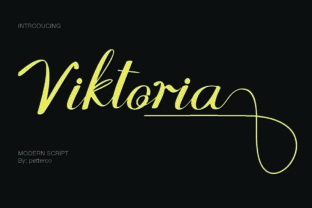
Viktoria Font
Viktoria is a contemporary serif typeface designed with refined proportions, subtle contrast, and carefully considered letterforms. It balances classical typographic structure—such as bracketed serifs and moderate stroke variation—with a streamlined, uncluttered aesthetic that feels at home in modern digital and print environments. Unlike many revivalist serifs, Viktoria avoids overt historical mimicry; instead, it interprets tradition through a restrained, present-day lens. Its design prioritizes clarity at small sizes and presence at larger ones, making it suitable for both body text and display use—though its strengths lean more toward headings, branding, and editorial applications.
Why Designers Consider Viktoria
Designers often explore Viktoria when seeking a serif font that communicates sophistication without formality, elegance without ornamentation. Its distinct character emerges in contexts where visual identity benefits from quiet confidence—think boutique brand identities, cultural institution communications, or premium editorial layouts. Because Viktoria’s letterforms avoid extreme contrast or exaggerated terminals, it reads smoothly across devices and maintains legibility in constrained spaces like mobile interfaces or tight caption areas.
Its uniqueness lies not in novelty for novelty’s sake, but in thoughtful deviations: the gently angled crossbar of the lowercase e, the open aperture of the a and c, and the slightly flared terminal on the uppercase R. These details contribute to rhythm and recognition without compromising neutrality. For readers evaluating typefaces, Viktoria stands out not by shouting, but by holding space with intention.
Practical Benefits and Realistic Expectations
Viktoria supports a broad range of Latin-based languages and includes standard OpenType features such as ligatures, small caps, old-style figures, and stylistic alternates. This makes it adaptable for multilingual publishing and typographically nuanced projects. Its variable font version (where available) allows fine-grained control over weight and width, supporting responsive typography strategies without loading multiple static files.
However, expectations should align with its design intent. Viktoria is not optimized for high-density information environments—such as dense financial reports or technical documentation—where ultra-legible, highly functional serifs like Charter or Merriweather may perform better. Its lighter weights, while graceful, can appear fragile at very small sizes or on low-resolution screens. Likewise, its relatively narrow x-height means it may not compete as effectively as more robust text faces in long-form reading scenarios where vertical space is limited.
When Viktoria Fits Well
Viktoria excels in situations where tone and texture matter as much as function. It’s a strong candidate for:
- Brand identity systems seeking timeless differentiation—especially for lifestyle, hospitality, or creative service brands aiming for understated authority;
- Editorial design in magazines or online publications with curated visual pacing, where headline hierarchy benefits from its expressive yet disciplined presence;
- Print collateral such as brochures, invitations, or exhibition catalogs where paper quality and intentional spacing amplify its subtleties;
- Web headers and hero sections where controlled typographic contrast enhances scannability without sacrificing refinement.
In each case, success depends less on Viktoria alone and more on how it interacts with supporting type—particularly sans-serif companions for body text. Its warmth and structure pair well with neutral, humanist sans-serifs like Inter, Poppins, or even a restrained version of Helvetica Neue. Avoid pairing it with overly geometric or rigid sans-serifs unless contrast is deliberately sought.
When Alternatives May Be More Suitable
Viktoria may be less appropriate for projects requiring maximum accessibility or broad compatibility. For example, government websites, educational platforms, or healthcare communications often prioritize WCAG-compliant contrast ratios and tested readability metrics—areas where more utilitarian serifs (e.g., Source Serif Pro, PT Serif) or even well-optimized sans-serifs (e.g., Roboto Serif, IBM Plex Serif) offer stronger baseline performance.
Likewise, designers working under tight budget or licensing constraints should verify Viktoria’s availability and usage terms. While some versions are offered through subscription services like Adobe Fonts, others require one-time purchase or custom licensing—especially for extended use in apps or embedded systems. Free alternatives with similar sensibilities—such as Cormorant Garamond or Playfair Display—may serve as viable starting points for prototyping, though they differ in construction, spacing, and optical tuning.
Making an Informed Choice
Evaluating Viktoria effectively means moving beyond aesthetics to examine workflow integration and long-term maintainability. Before committing, test it in your actual environment: render it alongside your intended body typeface at multiple sizes and weights; check rendering consistency across Chrome, Safari, and Firefox; assess how it behaves with dynamic content (e.g., CMS-generated headlines with varying lengths). Pay attention to line breaks, hyphenation patterns, and how punctuation anchors visually within paragraphs.
Also consider your audience’s context. A luxury fashion brand targeting international audiences may value Viktoria’s distinctive voice and multilingual support. A nonprofit launching a community health campaign may benefit more from a font with proven legibility in diverse literacy contexts—even if it lacks stylistic distinction.
Finally, recognize that type choice is rarely binary. Viktoria doesn’t need to “replace” another serif—it may complement existing assets. Many successful implementations use it selectively: for logos, section titles, or pull quotes—while relying on more versatile workhorses for body copy. That kind of layered, purpose-driven application often yields stronger results than wholesale adoption.
Next Steps for Evaluation
If Viktoria aligns with your project’s tonal goals and technical requirements, begin with a trial version if available. Export real content—not lorem ipsum—into mockups that reflect actual layout constraints. Compare side-by-side with two or three alternatives that share its general category (modern serif) but differ in x-height, contrast, or stress axis. Note where each gains or loses clarity, rhythm, or emphasis.
Remember: no single font solves every challenge. Viktoria offers a particular kind of elegance—one rooted in restraint and precision. Whether it serves your needs depends not on its inherent qualities alone, but on how those qualities intersect with your content, audience, medium, and objectives.