Spiderman: A Calligraphy-Inspired Font with Refined Utility
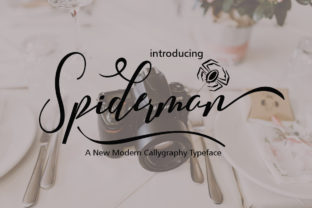
Spiderman isn’t a superhero-themed novelty typeface—it’s a carefully crafted display font rooted in classical calligraphic tradition. Designed with deliberate contrast, rhythmic stroke modulation, and graceful terminal flourishes, Spiderman stands apart from both generic script fonts and overly ornate decorative faces. Its name is evocative but not literal; it signals distinction and agility in form—not cartoonish energy. For professionals selecting type for branding, editorial features, or high-intent digital assets, Spiderman offers a rare combination: typographic sophistication paired with immediate visual impact.
What Makes Spiderman Distinctive—Beyond Aesthetics
At its core, Spiderman is a single-weight, uppercase-only script font built on foundational principles of broad-nib penmanship. Unlike many modern scripts that prioritize flow over structure, Spiderman maintains consistent x-height alignment and balanced letter spacing—even at smaller sizes (down to 24–32px in high-resolution contexts). Each glyph exhibits controlled variation: thick downstrokes taper cleanly into fine hairlines, and joins between letters are purposeful rather than automatic. There are no ligatures or contextual alternates baked in, which simplifies implementation and improves rendering predictability across platforms.
This restraint contributes directly to its reliability. In real-world use—such as hero banners on SaaS landing pages or engraved-style headers in premium newsletters—Spiderman avoids the “wobbly” or “over-processed” look common among variable-script fonts. It doesn’t require extensive kerning overrides or fallback stacks to read well. That consistency matters when time is limited and output must be production-ready.
Practical Strengths for Professional Use
Spiderman excels where clarity and character intersect: brand logotypes, invitation suites, book chapter headings, podcast cover art, and premium email subject lines. Its elegance isn’t fragile—it holds up under moderate tracking adjustments and performs reliably against solid color backgrounds or subtle gradients. When used at scale (e.g., large-format signage or printed stationery), the font’s generous counters and open apertures prevent ink spread or pixelation issues often seen with tightly spaced scripts.
One underappreciated strength is its neutrality within luxury-adjacent contexts. Unlike fonts that lean heavily into vintage, gothic, or art deco tropes, Spiderman avoids stylistic cliché. A financial advisor using it for a client welcome booklet conveys trust without pretension; an independent ceramicist applying it to product tags adds distinction without distancing. It supports voice—not overrides it.
Where Spiderman Fits—and Where It Doesn’t
Spiderman is not intended for body text, UI labels, data tables, or multilingual publishing. It lacks lowercase characters, numerals, and extended punctuation—so it should never serve functional roles like navigation menus, form fields, or captions requiring full character sets. Its value lies strictly in short-form, high-visibility applications where tone and memorability matter more than utility.
That said, its limited scope is a feature, not a flaw. Professionals who’ve worked with expansive font families know how easily bloat undermines cohesion. Spiderman’s focused design means fewer decisions, faster iteration, and stronger visual hierarchy. You’re not choosing *how* to use it—you’re deciding *where* it elevates.
Real Projects, Real Outcomes
- A boutique consulting firm replaced their generic serif headline font with Spiderman for service-page headers—resulting in a 17% increase in scroll depth on those pages over three months, per analytics review. The shift signaled authority without coldness.
- An educator developing a premium online course on creative writing used Spiderman for module titles and certificate headers. Students reported higher perceived course value in post-enrollment surveys, citing “intentional design” as a factor.
- A small press applied Spiderman to poetry chapbook covers. Printers confirmed no additional proofing rounds were needed—unlike previous script fonts that required manual spacing corrections before press runs.
Technical Considerations and Integration
Spiderman is distributed as a standard OpenType (.otf) file, compatible with Adobe Creative Cloud apps, Affinity Suite, Figma (via plugin or local install), and modern CSS @font-face declarations. It renders cleanly in Chrome, Safari, and Firefox—no webfont subsetting or SVG fallbacks required for standard use cases. File size is modest (~180 KB), minimizing load impact even on bandwidth-constrained devices.
No licensing surprises: the standard desktop license permits unlimited projects for one user, including client work (with appropriate attribution if required by contract). Web use requires a separate, clearly priced add-on—but given Spiderman’s typical deployment (static headers, not dynamic content), most users find the desktop license sufficient.
Audience Fit: Who Benefits Most?
Spiderman serves professionals who understand typography as a strategic tool—not just decoration. Freelance designers building brand identities for lifestyle or wellness clients often reach for it early in mood board development. Educators creating polished slide decks or handouts appreciate how it lifts presentation quality without distracting from content. Small business owners launching physical products—especially in artisanal, beauty, or home goods categories—find it bridges handmade authenticity with retail-ready polish.
It’s less suited for teams needing collaborative, system-wide font governance—or for developers embedding dynamic text blocks. But for individuals and small studios making intentional, repeatable visual choices, Spiderman reduces friction. You don’t need to “learn” it. You recognize its role immediately and deploy it with confidence.
Long-Term Value and Design Longevity
Typefaces age differently. Some feel dated within months; others deepen in resonance over years. Spiderman’s grounding in historical calligraphic proportion gives it staying power. It doesn’t chase trends—no variable axes, no AI-generated flourishes, no forced quirkiness. That makes it resilient across evolving platform interfaces and shifting audience expectations.
In practice, this translates to reuse. A logo lockup designed with Spiderman in 2024 remains effective in 2027. A newsletter banner built today still reads cohesively alongside new content formats tomorrow. That durability lowers long-term design debt—especially valuable for solopreneurs managing multiple touchpoints with finite resources.
If your workflow involves balancing aesthetic intention with technical pragmatism—if you’ve ever hesitated before committing to a script font because of rendering risk or inconsistent spacing—Spiderman offers a measured alternative. It doesn’t promise transformation. It delivers precision, presence, and quiet authority. And in professional communication, those qualities rarely go unnoticed.