Natural Marker: Why Hand-Drawn Authenticity Is Reshaping Design for Professionals and Brands
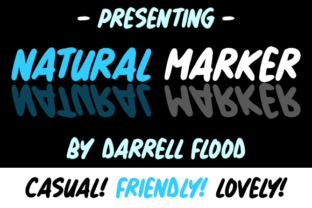
In an era defined by algorithmic precision, AI-generated assets, and hyper-polished interfaces, a quiet but powerful counter-trend is gaining momentum—one rooted not in code, but in the human hand. Natural Marker is more than a font: it’s a deliberate, tactile response to digital fatigue, a typographic tool that bridges intentionality and immediacy. Designed as a neat, hand-written font in a thick felt-tip marker style, Natural Marker captures the warmth, slight irregularity, and confident energy of real-world mark-making—ideal for whiteboards, signage, food packaging, and any context where clarity meets character.
A Font That Feels Human—Without Sacrificing Function
Unlike decorative script fonts that prioritize flourish over legibility—or rigid system fonts that erase all trace of personality—Natural Marker strikes a rare balance. Its letterforms are consistently spaced and carefully kerned, yet retain subtle variations in stroke weight, baseline rhythm, and terminal angles. This isn’t “imperfection for imperfection’s sake.” It’s intentional variation: engineered to mimic how a skilled hand moves across a surface—pressing slightly harder on downstrokes, lifting lightly at exits, pausing with purpose.
This makes Natural Marker unusually versatile for professional use. A marketing team can deploy it in a social media carousel without sacrificing scannability. A food brand can print it directly onto kraft paper labels or reusable glass jars—and instantly signal craft, transparency, and approachability. A freelance designer can embed it into a client presentation deck to reinforce a “live workshop” aesthetic before even opening the whiteboard app.
Aligning With the Rise of Intentional Design
The growing resonance of Natural Marker reflects deeper shifts across creative and commercial landscapes. Consider three converging trends:
- Authenticity as infrastructure: Consumers no longer reward polish alone—they reward proof of process. Whether it’s behind-the-scenes reels showing recipe development or packaging that bears visible ink texture, audiences increasingly associate handmade cues with integrity. Natural Marker functions as a visual shorthand for this ethos—not because it looks “rough,” but because it looks authored.
- Hybrid workflows are now standard: Today’s professionals rarely operate in silos. A product manager sketches user flows on a physical whiteboard, then imports them into Figma; a chef documents daily specials in a notebook before posting to Instagram Stories. Natural Marker serves as a unifying visual thread across analog and digital touchpoints—reinforcing continuity without requiring custom illustration or manual redrawing.
- Attention economy recalibration: With average dwell time on digital content shrinking, designers are prioritizing instant recognition over ornamental complexity. Natural Marker delivers high contrast, generous x-height, and open counters—all contributing to rapid readability at small sizes and on low-resolution screens. Its thickness ensures impact even in ambient lighting, like a café menu board viewed from across the room.
Why Professionals Are Choosing Natural Marker—Not Just Using It
It’s one thing to download a trendy font. It’s another to integrate it meaningfully into strategy. Here’s how forward-thinking creators are doing just that:
Food & Beverage Brands Building Trust Through Typography
Small-batch producers—from cold brew roasters to fermented hot sauce makers—are using Natural Marker on ingredient lists, batch numbers, and seasonal labels. One regional kombucha brand replaced its minimalist sans-serif label typography with Natural Marker for limited-edition flavors. Result? A 22% increase in in-store engagement (measured via staff-reported customer questions) and stronger alignment with their “small-batch, hand-crafted” messaging. The font didn’t change their process—but it made their process *visible*.
Freelancers and Agencies Communicating Process Transparency
A UX consultant recently began using Natural Marker exclusively for annotated wireframes and journey map callouts—not as decoration, but as a signal: “This is still in active collaboration. Edits welcome.” Clients reported feeling less intimidated by early-stage deliverables and more confident in co-creation. The font became part of her service language—a nonverbal cue that reinforced her methodology.
Educators and Workshop Facilitators Reinforcing Cognitive Accessibility
In learning design, research shows that moderate visual texture improves retention for neurodiverse audiences. An instructional designer working with corporate clients introduced Natural Marker into slide decks for key takeaways and reflection prompts. Feedback highlighted improved focus during virtual sessions—particularly when paired with ample whitespace and consistent color blocking. The font’s inherent “hand-drawn” quality reduced perceived cognitive load, making complex frameworks feel more digestible.
More Than Aesthetic: A Shift in How We Value Craft
The adoption of Natural Marker points to a broader re-evaluation of craft—not as nostalgia, but as operational discipline. In software development, we value clean architecture and readable code. In writing, we prize clarity and concision. In typography, Natural Marker represents a parallel commitment: to making choices that serve both function and feeling, simultaneously.
This matters because tools shape behavior. When a marketer selects a font that invites annotation, they’re more likely to leave space for feedback. When a packaging designer chooses a typeface that resists over-refinement, they’re implicitly resisting the pressure to over-engineer. Natural Marker doesn’t ask users to “go analog”—it asks them to bring analog sensibilities into digital execution.
Integrating Natural Marker Into Professional Workflows—Practically
Adoption isn’t about wholesale replacement—it’s about strategic placement. Here’s how teams are applying it with intention:
- Define clear usage boundaries: Reserve Natural Marker for primary headlines, short calls-to-action, and illustrative annotations—not body copy or data tables. Its strength lies in emphasis, not endurance.
- Pair deliberately: Combine it with a neutral, highly legible sans-serif (e.g., Inter, IBM Plex Sans, or even system fonts like San Francisco or Segoe UI) for supporting text. This creates visual hierarchy while preserving accessibility compliance.
- Test across contexts: Print samples on actual substrate (kraft paper, recycled cardboard, matte vinyl), preview on multiple devices, and check contrast ratios. Its thickness works well on textured surfaces—but only if the background supports sufficient luminance contrast.
- Leverage variable options (if available): Some versions of Natural Marker include weight or width variants. Use lighter weights for secondary accents, bolder weights for environmental signage—extending its utility without compromising voice.
Looking Ahead: Typography as a Signal of Values
As generative tools accelerate production speed, the value of human judgment grows—not in spite of automation, but because of it. Natural Marker thrives in this landscape not as a relic, but as a calibrated instrument: precise enough for professional deployment, expressive enough to carry meaning.
Its relevance won’t fade with the next design trend. Instead, it will deepen—as more organizations recognize that trust isn’t built through perfection, but through consistency of intent. When a startup uses Natural Marker on its first pitch deck, it’s not choosing a font. It’s signaling that its values are drawn, not generated. When a restaurant updates its chalkboard menu with Natural Marker, it’s not chasing whimsy—it’s affirming presence, care, and the quiet confidence of doing something well, by hand.
That’s why Natural Marker belongs in the toolkit of today’s most thoughtful professionals—not as decoration, but as declaration.