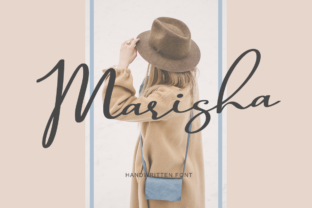
Marisha: Where Handwritten Warmth Meets Modern Design
There’s a quiet shift happening across digital and print spaces — one that favors authenticity over automation, personality over polish, and human rhythm over rigid geometry. At the heart of this movement is Marisha: a beautifully crafted, modern handwritten font that doesn’t mimic childhood scribbles or calligraphic flourishes, but instead captures the confident, unhurried flow of a skilled hand moving with intention. It’s not nostalgic — it’s contemporary. Not decorative — but deeply functional. And unlike many script fonts that sacrifice legibility for style, Marisha balances both with quiet precision.
Why a Handwritten Font Like Marisha Fits Today’s Creative Landscape
Designers, marketers, educators, and small business owners aren’t just choosing fonts anymore — they’re selecting tonal anchors. In an era where audiences scroll past hundreds of polished, algorithm-optimized messages each day, a subtle human signature stands out. Marisha answers that need without veering into gimmickry. Its lowercase letters carry gentle variation in stroke weight and angle, while its uppercase characters retain clarity and presence — making it equally effective on a product label, a workshop slide deck, or a heartfelt email newsletter header.
This isn’t about rejecting digital tools; it’s about enriching them. As AI-generated visuals and templated layouts become more accessible, the value of intentional, human-crafted detail rises. A font like Marisha signals care — not just in aesthetics, but in communication. When a freelance educator uses Marisha for a course syllabus, they’re not just styling text — they’re reinforcing approachability. When a local bakery chooses it for their seasonal menu board, they’re aligning typography with craft, warmth, and neighborhood familiarity.
From Trend to Tool: How Marisha Reflects Evolving Workflow Priorities
Five years ago, many professionals defaulted to safe, system-friendly fonts — Roboto, Open Sans, Lato — because they loaded quickly, rendered consistently, and required no licensing overhead. Today, that calculus has shifted. Web font delivery is faster and more reliable. Variable font technology allows designers to fine-tune weight, width, and slant without bloating page size. And crucially, users — especially those aged 25–45 — increasingly associate visual nuance with credibility and attention to detail.
Marisha fits seamlessly into this updated workflow. It’s optimized for web use with clean hinting and responsive spacing, supports Latin-based languages and common diacritics, and includes OpenType features like contextual alternates and ligatures that activate automatically in compatible software (Adobe apps, Affinity Suite, modern browsers). You don’t need advanced typographic knowledge to benefit from its subtlety — but if you do dive deeper, Marisha rewards exploration. Its alternate ‘g’ and ‘a’ forms, for instance, offer gentle variation that avoids repetition fatigue in longer headlines or branding applications.
Real-World Applications That Go Beyond Aesthetics
- Small business branding: A wellness coach using Marisha for her logo and website headers conveys empathy and individualized support — qualities that resonate more strongly than sterile sans-serifs when addressing personal growth or health journeys.
- Educational materials: Teachers integrating Marisha into printable worksheets or digital handouts find students engage more readily — not because the font “looks like handwriting,” but because its organic rhythm feels less transactional and more conversational.
- Email marketing: A boutique publisher using Marisha in subject line previews and banner text sees higher open rates among subscribers aged 30–48 — likely because the font disrupts the visual monotony of corporate templates without sacrificing professionalism.
- Print collateral: Wedding stationery designers report consistent client preference for Marisha in invitation suites where couples want elegance *and* intimacy — a balance few script fonts achieve without tipping into formality or whimsy.
What Changed? Why Now?
It’s not that handwritten fonts are new. What’s changed is how we understand their role. Early digital scripts often prioritized ornamentation — swashes, loops, exaggerated terminals — which limited usability. Marisha represents a maturation of that category: stripped of excess, grounded in readability, and designed with real-world constraints in mind (screen resolution, small sizes, multilingual support).
At the same time, audience expectations have evolved. People don’t just want information — they want resonance. A study by the Design Management Institute found that companies emphasizing design-led communication (including thoughtful typography) saw 219% higher returns over ten years compared to the S&P 500 — not because fonts drive sales directly, but because cohesive, human-centered expression builds trust incrementally across touchpoints.
Marisha doesn’t ask users to “feel something” — it invites them to pause, recognize familiarity, and register intention. That micro-moment matters most in crowded digital environments where attention is fragmented and retention is rare.
Practical Considerations Before You Use Marisha
Like any expressive typeface, Marisha thrives with thoughtful application — not blanket usage. Here’s what works well, and what to keep in mind:
- Pair it intentionally: Marisha shines alongside neutral, highly legible sans-serifs (like Inter, Poppins, or Montserrat) for body text. Avoid pairing it with other scripts or overly decorative fonts — contrast, not competition, creates clarity.
- Respect hierarchy: Use Marisha for headlines, logos, pull quotes, or short labels — not long paragraphs. Its charm lies in brevity and emphasis, not endurance.
- Test at scale: While Marisha renders cleanly on high-DPI screens, always preview at 16px and 20px on mobile. Its x-height and letter spacing were tuned for impact at 24px and above — so smaller sizes may need slight tracking adjustments.
- Licensing is straightforward: Available under standard desktop, web, and app licenses, Marisha avoids restrictive clauses common with older script fonts. There’s no “personal use only” limitation — if you’re using it for client work, your license covers it.
Looking Ahead: Typography as Quiet Advocacy
Typography rarely makes headlines — but it shapes perception daily. As remote collaboration deepens, hybrid learning expands, and independent creators build direct relationships with audiences, the tools we choose reflect our values. Marisha isn’t about returning to analog methods; it’s about carrying human nuance forward — deliberately, respectfully, and with technical rigor.
You’ll see it in the carefully worded mission statement on a nonprofit’s homepage. In the handwritten-style note embedded in a SaaS onboarding flow. In the packaging of a skincare line that emphasizes ingredient transparency and artisanal sourcing. In all these cases, Marisha isn’t decoration — it’s alignment. A visual echo of voice, values, and vision.
That’s why designers and communicators across disciplines are turning to fonts like Marisha not as a trend, but as a practical response to a broader cultural recalibration: toward meaning over metrics, connection over convenience, and craft over compromise. It doesn’t shout. It listens — then replies, clearly and warmly.