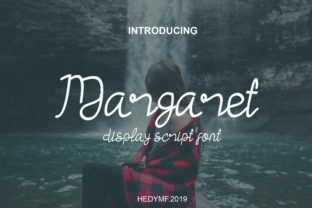
Margaret: Where Delicate Handwriting Meets Modern Design Sensibility
There’s a quiet confidence in handwriting that feels personal, intentional, and human—especially when it’s done well. Margaret isn’t just another script font. It’s a carefully crafted balance: delicate enough to whisper elegance, sophisticated enough to hold its own in high-end branding, and distinctive enough to stand out without shouting. If you’ve ever scrolled through a font library searching for something that feels both timeless and freshly relevant, you’ve likely paused on Margaret—and wondered why it works so well.
A Font That Breathes With Your Design
What makes Margaret feel alive? It starts with rhythm. Unlike rigid calligraphic fonts that rely heavily on strict contrast or exaggerated flourishes, Margaret uses subtle variation in stroke weight, gentle tapering, and organic spacing to mimic the natural flow of ink on paper. The lowercase “a” has a soft, open bowl; the “g” features a graceful, looping descender; and the “s” curves with quiet intention—not too tight, not too loose. These aren’t arbitrary details. They’re design decisions rooted in legibility, personality, and emotional resonance.
This isn’t a font designed for dense paragraphs or technical documentation. Margaret thrives where attention is earned—not demanded. Think luxury packaging labels, boutique wedding invitations, artisanal product tags, or editorial mastheads. In those contexts, every letter carries weight—and Margaret delivers that weight with grace.
Why “Delicate” Doesn’t Mean “Fragile”
Calling Margaret delicate might conjure images of brittle typography—easily overwhelmed, hard to scale, or unsuitable for digital use. But that’s not the reality. Its delicacy lies in refinement, not weakness. The letterforms are precisely engineered to retain clarity at sizes as small as 14px in UI settings (with appropriate line height and contrast), and they bloom beautifully at 48px+ in hero banners or signage.
Test it yourself: set a short headline in Margaret against a muted background—say, warm ivory or soft charcoal—and watch how it anchors the composition without competing. It doesn’t dominate; it invites. That’s a rare quality in today’s oversaturated visual landscape.
Fitting Margaret Into Real-World Workflows
Designers don’t pick fonts in a vacuum—they consider compatibility, licensing, file formats, and integration speed. Margaret was built with modern production in mind. It ships with full OpenType support, including standard and discretionary ligatures, stylistic alternates, and multilingual character sets covering Latin-based European languages. That means you can type “coffee & co.” and see the ampersand automatically swap to a custom, hand-drawn version—or toggle between two distinct “t” endings depending on context.
- Web projects? Available via most reputable font hosting services (like Adobe Fonts or self-hosted WOFF2 files), with optimized hinting for crisp rendering across devices.
- Brand identity systems? Works seamlessly alongside clean sans-serifs (think Inter or Poppins) for contrast that feels intentional—not jarring.
- Print collateral? Prints flawlessly at high DPI, especially on uncoated or textured stocks where its organic texture enhances, rather than fights, the paper grain.
One designer recently used Margaret for a small-batch olive oil label paired with a minimalist serif for ingredient copy. The result? A shelf presence that felt artisanal but never twee—sophisticated, grounded, and unmistakably human.
When Margaret Shines—and When to Pause
Like any expressive typeface, Margaret has sweet spots—and boundaries. It excels in short-form, high-impact applications: logos, quotes, chapter headings, social media visuals, and product names. It adds warmth to digital interfaces where users need reassurance—think wellness apps, therapy platforms, or slow-living blogs.
Where it steps back: long-form body text, data dashboards, legal disclaimers, or environments with low contrast or poor screen resolution. You wouldn’t use a Stradivarius to hammer nails—and similarly, Margaret isn’t meant to carry functional weight. That’s not a limitation; it’s focus.
If your project hinges on immediate readability under time pressure (like emergency signage or airport wayfinding), reach for something sturdier. But if your goal is to evoke care, craft, or quiet confidence? Margaret is often the first—and last—font you’ll need to try.
Pairing Margaret Thoughtfully
Typography pairing isn’t about rules—it’s about conversation. Margaret speaks softly, so its companion should listen closely. Avoid other scripts or overly decorative fonts that compete for attention. Instead, lean into contrast through structure:
- Geometric sans-serifs like Montserrat or Futura create a compelling tension—modern meets handmade, precision meets personality.
- Low-contrast serifs such as Charter or PT Serif add literary warmth without overwhelming Margaret’s subtlety.
- Monospaced fonts (used sparingly) can ground Margaret in digital authenticity—great for tech brands adding a human layer to their voice.
One effective trick: use Margaret for the primary brand mark, then switch to a neutral, highly legible font for all supporting text—including URLs, contact info, and copyright lines. This keeps hierarchy clear while letting Margaret do what it does best: make a memorable first impression.
What Users Really Consider Before Choosing Margaret
Before committing, designers and brand teams often ask practical questions—and rightly so. Here’s what matters most:
- Licensing scope: Does it cover web, app, desktop, and print? Most reputable vendors offer clear tiered plans—confirm usage limits before launch.
- Character coverage: Need accented characters for French, Spanish, or Scandinavian markets? Check the glyph set. Margaret typically includes extended Latin support—but verify for your specific language needs.
- Load performance: Self-hosted WOFF2 files are lightweight (<50 KB), but embedding via third-party services may add latency. Test real-world load times on mobile.
- Brand alignment: Does Margaret reflect your values? If your brand is bold, disruptive, or hyper-technical, it may feel tonally misaligned—even if it’s beautiful.
Also worth noting: Margaret has inspired thoughtful knockoffs—but only the original delivers consistent spacing, optical sizing, and nuanced alternates. Cutting corners here often shows up in kerning gaps, uneven baseline alignment, or missing punctuation glyphs.
A Contemporary Spin, Rooted in Craft
“Contemporary” doesn’t mean trend-driven—it means responsive, adaptable, and human-centered. Margaret achieves that by honoring tradition (its roots trace back to pointed-pen calligraphy) while embracing digital fluency (OpenType features, responsive metrics, cross-platform reliability). It doesn’t chase novelty; it refines meaning.
In an age of AI-generated visuals and algorithmic layouts, choosing Margaret is a small act of intentionality. It signals that you value the hand behind the design—the pause before the stroke, the care in the curve, the thought in the space between letters. That resonance extends to audiences, too. People respond to authenticity, even in typography. They sense when something was made—not assembled.
Whether you’re launching a ceramic studio, redesigning a heritage bookstore’s website, or crafting a heartfelt email series for a mental wellness platform, Margaret offers more than aesthetics. It offers tone. Clarity. Quiet authority. And in the right context, it doesn’t just complement your message—it deepens it.