Jettwishes: Where Handwritten Energy Meets Design Integrity
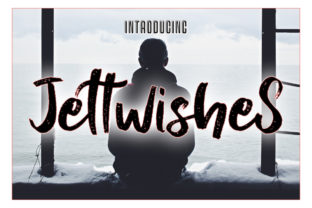
Typography is rarely just about letters—it’s about voice, rhythm, and human resonance. In a digital landscape saturated with geometric precision and algorithmically optimized fonts, Jettwishes arrives not as another option, but as a deliberate counterpoint: a fun and bold handwritten font that carries an unmistakably authentic feel. It doesn’t simulate handwriting—it embodies it. Its strokes breathe, its angles surprise, and its irregularities aren’t flaws; they’re signatures of intention. For designers, educators, small business owners, and even researchers visualizing qualitative data, Jettwishes offers more than aesthetic flair—it delivers expressive clarity rooted in real-world legibility and emotional accessibility.
What Makes Jettwishes Distinctively Human?
Unlike many “handwritten” fonts that rely on repetitive glyph sets or overly stylized flourishes, Jettwishes was crafted with organic variation at its core. Each lowercase a, g, and s appears in multiple forms—some with looping tails, others with sharp flicks—activated automatically via OpenType contextual alternates. This means text set in Jettwishes avoids the robotic uniformity common in script fonts, instead mimicking how a person actually writes across phrases: relaxed at the start of a sentence, more decisive mid-line, slightly faster near the end. The uppercase letters retain structural confidence without sacrificing warmth—ideal for headlines that need to command attention while feeling approachable.
The weight distribution is equally thoughtful. Rather than flattening contrast for screen readability, Jettwishes preserves subtle thick-to-thin transitions—just enough to suggest pen pressure, but never so extreme that characters collapse at small sizes. At 16px on a standard display, body copy remains scannable; at 60px on a presentation slide, it radiates personality without visual noise. That balance—between expressiveness and function—is where Jettwishes earns its versatility.
Real-World Applications Across Diverse Fields
Because Jettwishes bridges authenticity and utility, its use cases span far beyond greeting cards or Instagram quotes. Consider how educators deploy it: a middle-school science teacher designing a classroom “Lab Safety Pledge” might choose Jettwishes for the signature line—not to mimic cursive instruction, but to reinforce the personal commitment behind the rules. Students see themselves in the font’s energy, making the document feel less like policy and more like shared responsibility.
Small business owners benefit equally. A ceramicist launching a new workshop series might use Jettwishes in email headers and printed handouts—not as a decorative afterthought, but as part of a cohesive tone. Here, the font signals craftsmanship, care, and non-corporate values without requiring illustration or custom lettering. Likewise, a neighborhood bookstore using Jettwishes for event posters communicates warmth and community before a single word is read. It’s typography as ambient messaging.
In research contexts, Jettwishes supports human-centered communication. Qualitative researchers presenting findings to non-academic stakeholders often struggle with dense, impersonal slides. Swapping sterile sans-serifs for Jettwishes in quote callouts or thematic headers introduces gentle emphasis—guiding attention while preserving the rawness of participant voices. One ethnographer noted using it specifically for verbatim field notes in public-facing summaries: “It reminds viewers these aren’t abstract categories—they’re spoken words, shaped by real people.”
Practical Integration: What Designers and Non-Designers Should Know
Adopting Jettwishes doesn’t require advanced typographic training—but understanding its behavior does prevent missteps. First, it thrives with breathing room. Tight letter-spacing (tracking) undermines its natural flow; default or slightly increased tracking (e.g., +10–+20 units in design software) lets each character settle into its rhythm. Second, pairing matters. Jettwishes pairs most effectively with neutral, highly legible typefaces—think Inter, Source Sans Pro, or even well-hinted Georgia—not other decorative fonts. The contrast creates hierarchy without competition: Jettwishes leads; the companion face supports.
For web use, Jettwishes is available in WOFF2 format with comprehensive Unicode coverage (Latin-1, basic Latin Extended-A, punctuation, and common diacritics). It renders reliably across modern browsers and supports variable font features where implemented—though its current release is static, prioritizing stability over interpolation complexity. Developers embedding it via @font-face should preload critical displays (e.g., hero headings) and define fallback stacks that preserve meaning: font-family: "Jettwishes", "Comic Neue", "Chalkboard SE", cursive;. That progression ensures graceful degradation without sacrificing tone.
Print workflows also reward attention. When outputting to physical media—especially uncoated paper or fabric labels—test at actual size. Jettwishes’ fine terminals hold up well on laser printers and high-DPI inkjets, but thermal printers or low-resolution plotters may soften delicate exits. In those cases, slight stroke expansion (via outline conversion) or selective use of its bolder cut (if available in future releases) maintains impact.
When Jettwishes Isn’t the Right Choice
Authenticity has boundaries—and Jettwishes respects them. It’s intentionally unsuited for interfaces requiring rapid scanning: navigation menus, data tables, legal disclaimers, or multilingual UIs with complex scripts. Its charm lies in moments of pause, reflection, or invitation—not transactional efficiency. Similarly, brands built on stark minimalism (e.g., luxury tech or clinical diagnostics) may find its vitality tonally dissonant. That’s not a limitation—it’s fidelity. A font shouldn’t stretch to fit every context; it should clarify which contexts it serves best.
Why “Fun and Bold” Doesn’t Mean “Casual”
There’s a quiet misconception that handwritten fonts signal informality—and therefore lack authority. Jettwishes challenges that assumption. Its boldness isn’t volume; it’s presence. Its fun isn’t frivolity; it’s engagement. A university continuing education program used Jettwishes for certificate headers alongside formal serif body text. Alumni reported the certificates felt “more memorable, more human”—not less rigorous. The font didn’t undermine credibility; it anchored it in relatability.
This distinction matters for creators weighing perceived professionalism against genuine connection. Jettwishes proves that warmth and competence coexist. Its x-height is generous, ascenders are clear, and word spacing avoids crowding—all hallmarks of considered typography, not impulsive doodling. Even its slant (a subtle 4° rightward lean) follows traditional calligraphic logic, aiding left-to-right reading momentum rather than disrupting it.
Evolving With Intention: What’s Next for Handwritten Typography?
Jettwishes reflects a broader shift in type design: away from universal solutions and toward context-aware tools. We’re seeing more fonts built with specific user needs in mind—not just “for websites” or “for logos,” but “for community bulletin boards,” “for bilingual children’s books,” or “for tactile signage.” Jettwishes fits squarely in that movement. Its development prioritized real usage feedback—from teachers adapting worksheets to makers labeling handmade goods—rather than theoretical idealism.
Looking ahead, accessibility enhancements remain a focus. While Jettwishes already exceeds WCAG AA contrast ratios at recommended sizes, future iterations may include expanded language support (e.g., Vietnamese diacritics, extended Cyrillic), optical sizing variants for immersive environments (AR overlays, large-format projections), and enhanced OpenType features for dynamic content generation—like auto-adjusting swashes based on word length. None of these would dilute its core identity. Instead, they’d deepen its capacity to serve people, not platforms.
Final Thought: Typography as Stewardship
Choosing Jettwishes isn’t merely selecting a typeface—it’s aligning with a design ethic that values imperfection as evidence of care, variation as a sign of attentiveness, and boldness as an act of clarity. Whether you’re a researcher illustrating empathy in data storytelling, a hobbyist crafting personalized gifts, or a startup founder defining brand voice before writing a single line of code, Jettwishes invites you to lead with humanity first. It doesn’t shout. It leans in. And in doing so, it transforms how messages land—not just what they say.
That’s the quiet power of a font built not for algorithms, but for people who read, reflect, and respond.