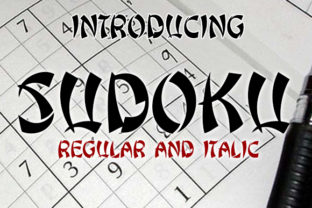
Sudoku: A Bold, Fun Decorative Font That Commands Attention
When you see the word Sudoku set in its namesake font, it doesn’t just say “puzzle”—it pops, pulses, and holds space like a confident headline at a gallery opening. Designed with playful geometry and crisp, high-contrast letterforms, Sudoku is a decorative display font that works brilliantly for logos, posters, social banners, packaging, and any project where personality and visual impact matter. But here’s what many overlook: choosing and using Sudoku well isn’t just about downloading the file—it’s about matching its boldness to your real-world context.
Why People Reach for Sudoku (and Why It Often Gets Misapplied)
Designers and non-designers alike are drawn to Sudoku because it feels energetic, modern, and approachable—like a friendly challenge wrapped in clean lines. It’s especially popular among educators creating classroom posters, small business owners refreshing their café menu boards, and bloggers designing Pinterest-worthy quote graphics. Its playful yet structured aesthetic echoes the logic-and-fun duality of the classic number puzzle, making it feel intuitive—even when used far beyond game-related content.
But enthusiasm can outpace execution. Too often, people install Sudoku, type a headline, and stop there—without checking how it performs at different sizes, across devices, or alongside other fonts. That’s where clarity starts to blur, and impact quietly unravels.
1. Using Sudoku for body text—or even medium-length headlines
Sudoku was built for emphasis, not endurance. Its tight spacing, exaggerated terminals, and strong stroke contrast make it difficult to read in paragraphs or even in multi-line headings under 36px. Try setting a blog title like “5 Ways to Boost Your Morning Routine” in Sudoku at 24px on a mobile screen—you’ll likely see letters merge, spacing collapse, and readability drop sharply.
Better approach: Reserve Sudoku for short, high-impact uses—logos (“Brew & Bloom Café”), event banners (“SOLVING SUNDAYS”), or single-word callouts (“YES”, “NEW”, “LAUNCH”). Pair it with a highly legible sans-serif (like Inter, Lato, or Open Sans) for supporting text. This contrast creates hierarchy—not competition.
2. Assuming all “Sudoku” font files are equal
You’ll find dozens of free downloads labeled “Sudoku font” online—but many are low-quality recreations, missing essential OpenType features, inconsistent kerning, or even misnamed characters. Some lack bold or italic variants. Others contain only uppercase letters or skip numerals entirely—problematic if you’re designing a puzzle book cover or math-themed workshop flyer.
Better approach: Before downloading or purchasing, check the character set preview. Look for support of Latin-1 (including accented characters), numerals, punctuation, and at minimum one weight (Regular or Bold). Reputable sources like Google Fonts (if available), Adobe Fonts, or verified independent foundries provide specimen pages and licensing clarity. If a site offers no preview, no license info, and no designer attribution—pause and look elsewhere.
3. Overlooking technical fit—especially for web and print
Using Sudoku on a website without proper web font optimization can slow load times or trigger invisible fallbacks. In print, embedding issues or missing outlines may cause text to shift or render inconsistently across machines. And crucially: Sudoku has no built-in variable axes (like weight or width), so you can’t fluidly adjust it like a variable font—meaning you need separate files for each style you intend to use.
Better approach: For web, convert Sudoku to WOFF2 (the most efficient format) and serve it with @font-face using font-display: swap to avoid invisible text. For print, always outline text before sending to a printer—or embed fonts fully in PDF/X-4. And if you need multiple weights, confirm they’re included *before* finalizing your layout.
What to Check Before You Commit
Before adding Sudoku to your toolkit—or launching a design that depends on it—ask yourself these five questions:
- Is the message short enough? If it’s longer than 3–4 words, test readability at your target size and distance (e.g., viewed on a phone held at arm’s length).
- Does it coexist well with my other fonts? Try pairing it with your primary body font in grayscale first—does contrast feel intentional, or chaotic?
- Are accents, symbols, or numbers needed? Type “café,” “München,” “2024,” and “$9.99” to verify coverage.
- Is licensing clear and appropriate? Free-for-personal-use licenses don’t cover client work, e-commerce banners, or app interfaces. Commercial licenses vary—read the terms, not just the price.
- Does it reflect the tone I actually want? Sudoku leans upbeat and clever—not serious, minimalist, or luxurious. If your brand voice is calm and authoritative (e.g., a financial advisor or healthcare provider), this font may unintentionally undercut trust.
A Realistic Example: From Mistake to Stronger Choice
Imagine a freelance educator designing a summer camp flyer titled “Math Magic Camp: Where Numbers Come Alive!” She sets the full title in Sudoku at 28px, then adds bullet points in the same font. The result? The headline struggles to breathe; the bullets vanish into visual noise.
The fix wasn’t swapping fonts—it was refining intent. She kept Sudoku for just “MATH MAGIC CAMP” (all caps, 48px), added subtle tracking (+50), and switched bullets and details to a warm, rounded sans-serif (like Quicksand) at 18px. Suddenly, the hierarchy worked: energy up top, clarity below. Parents scanned and understood in under three seconds—not because the font changed, but because its role did.
Final Thought: Let Sudoku Shine—Without Carrying the Load
Sudoku isn’t a utility font—and that’s its strength. Used thoughtfully, it adds wit, warmth, and memorability to designs that benefit from a dash of structured fun. But like a bright accent wall in interior design, its power comes from restraint and intention—not coverage. When you match its bold personality to the right moment, size, and context, it stops being just another font—and becomes the reason someone pauses, smiles, and remembers.