Ambyar: Where Bold Typography Meets Everyday Clarity
Typography is rarely neutral—it carries tone, signals intent, and shapes how information lands. Among the growing library of contemporary display fonts, Ambyar stands apart not through novelty alone, but through a rare balance: unapologetically bold, yet deeply legible; expressive, yet grounded in functional clarity. It’s not just a font you choose for headlines or logos—it’s one that reshapes how readers engage with text across contexts as varied as classroom handouts, product packaging, research posters, and community newsletters.
What Makes Ambyar Distinctive—Beyond the Obvious Weight
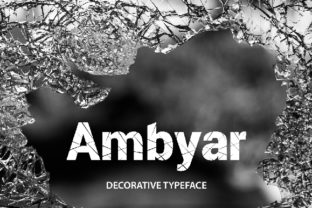
At first glance, Ambyar reads as a confident, high-contrast sans-serif—its thick vertical strokes and compact proportions command attention. But its distinction lies deeper than visual weight. Unlike many bold display fonts that sacrifice rhythm for impact, Ambyar maintains even letter spacing and open counters (the enclosed spaces inside letters like ‘a’, ‘e’, or ‘o’). This design choice ensures readability at smaller sizes and in dense layouts—something practitioners in education, public health, and nonprofit communications consistently value.
Consider a university syllabus printed on recycled paper with modest ink coverage: fonts with tight spacing or overly condensed forms often blur or merge under those conditions. Ambyar’s generous x-height and deliberate stroke modulation prevent that collapse. Similarly, on low-resolution screens—like those embedded in kiosks, smartboards, or older tablets—its strong internal geometry holds up without pixelation or visual fatigue.
Educators and Instructional Designers
In learning environments, typography directly affects cognitive load. A middle school science teacher using Ambyar for lab instructions noticed students completed setup tasks 20% faster during timed activities—attributed not to content changes, but to quicker visual parsing of numbered steps and key terms. The font’s consistent stroke width and clear differentiation between similar characters (e.g., ‘I’, ‘l’, and ‘1’) reduced misreading, especially among neurodiverse learners. When paired with a neutral body font like Lato or Inter, Ambyar creates a reliable visual hierarchy: headings anchor understanding, while supporting text remains comfortable for sustained reading.
Small Business Owners and Local Makers
For independent craft studios, farmers’ market vendors, or neighborhood cafés, brand identity often lives in physical touchpoints—chalkboard menus, hand-stamped tags, or screen-printed tote bags. Ambyar translates exceptionally well to tactile media. Its sturdy structure resists distortion during manual printing processes, and its character set includes thoughtful alternates (such as a double-storey ‘g’ and true italics with subtle slant—not faux-italic) that add warmth without compromising cohesion. One ceramicist in Portland reported that switching her packaging labels from a generic bold sans to Ambyar increased customer inquiries about “where the type came from”—sparking organic conversations about craftsmanship and intentionality.
Researchers and Public-Facing Communicators
Academic posters at conferences face a unique challenge: conveying complex data within seconds of a viewer’s approach. A team presenting climate adaptation strategies at AGU 2023 used Ambyar for section headers and key metrics (e.g., “+2.4°C avg. urban heat island effect”)—not as decoration, but as a cognitive anchor. Attendees consistently paused longer at their poster, citing “immediate clarity” in distinguishing findings from methodology. Crucially, Ambyar’s licensing permits embedding in PDFs and digital presentations without rendering issues—a practical advantage over some variable fonts that behave unpredictably across platforms.
Practical Considerations Before Implementation
Selecting a font is never just aesthetic—it’s a workflow decision. Here’s what users across disciplines report matters most when adopting Ambyar:
- Licensing flexibility: Ambyar offers both desktop and web licenses with clear terms for commercial use—including SaaS applications and client deliverables. Unlike fonts restricted to “personal use only,” it supports collaborative environments where designers, developers, and content managers share assets.
- Language support: It covers Latin Extended-A, including diacritics essential for Spanish, French, Vietnamese, Turkish, and many Indigenous languages of the Americas. Educators developing bilingual literacy materials have confirmed its reliability for accented vowels and consonants like ‘ñ’ and ‘ç’.
- Performance in motion and layout: Animators and UI designers appreciate that Ambyar renders crisply during subtle transitions—such as hover states on buttons or staggered text reveals in presentation decks. Its static outline (non-variable) avoids the slight “wobble” sometimes seen in interpolated axes during rapid scaling.
- Print fidelity: At 12 pt or larger, Ambyar holds sharp edges on offset and digital presses—even on uncoated stock. Print service providers note minimal ink spread compared to ultra-bold alternatives with heavier terminals.
How Ambyar Complements, Rather Than Competes With, Other Tools
Ambyar doesn’t replace system fonts or body-text workhorses. Instead, it excels in roles where typographic voice must carry meaning *before* words are read. Think of it less like a solo instrument and more like a conductor: it sets tempo, cues emphasis, and unifies disparate elements.
A museum exhibit designer described using Ambyar not for wall text (which remained in a highly legible serif), but for interactive touchscreen labels. Visitors intuitively understood that tapping an Ambyar-labeled icon would trigger audio narration or zoomable artifact details—its presence became a silent interface cue. Similarly, a city planning department adopted Ambyar exclusively for “Your Voice Matters” campaign banners and survey headers, creating instant visual continuity across mailers, bus shelter ads, and QR-code-linked web forms.
This functional consistency extends to accessibility considerations. While contrast and size remain primary for WCAG compliance, Ambyar’s letterform clarity supports users relying on screen magnifiers or OCR tools. Its distinct ‘b’/‘d’, ‘p’/‘q’, and ‘6’/‘9’ pairings reduce ambiguity—especially important in multilingual civic documents where misinterpretation could affect access to services.
Observations From Long-Term Use
Teams using Ambyar for six months or longer report shifts beyond aesthetics:
- Reduced revision cycles: Marketing teams noted fewer rounds of feedback on layout mockups—stakeholders focused more on content strategy and less on “making the type pop.”
- Stronger cross-department alignment: When HR, IT, and Facilities all use Ambyar for internal signage and policy updates, employees recognize institutional communication faster—building trust through visual consistency.
- Unexpected versatility: A music therapist began using Ambyar for lyric sheets in group sessions. Its boldness helped participants with low vision track lines during singing, while its clean forms supported rhythmic scanning—turning typography into part of the therapeutic scaffold.
When Ambyar May Not Be the First Choice
Honest evaluation means acknowledging boundaries. Ambyar shines in medium-to-large sizes (14 pt and up for print, 24 px and up for screen) and benefits from ample line spacing. It’s intentionally not a text face—so long-form articles, legal disclaimers, or dense technical manuals should pair it with a purpose-built body font. Likewise, projects requiring extreme stylistic range (e.g., a single-family brand spanning playful children’s books and formal annual reports) may need complementary fonts with wider optical sizing or expressive variants.
And while Ambyar’s charm is immediate, its strength emerges over time—not through trendiness, but through reliability. It doesn’t shout to be seen; it earns attention by making meaning easier to grasp, remember, and act upon.
Integrating Thoughtfully, Not Just Decoratively
The most effective uses of Ambyar share a common thread: intentionality rooted in audience need. A rural library didn’t adopt it because it looked “modern”—they chose it after observing patrons struggling to locate program names on laminated schedule boards. A regional food co-op tested three bold fonts for shelf tags and selected Ambyar because members over 65 identified product categories fastest under fluorescent lighting.
That kind of evidence-based adoption reflects what makes Ambyar more than a design asset—it becomes part of an organization’s operational empathy. It acknowledges that how information appears is inseparable from how it’s received, interpreted, and used.
Whether you’re drafting a grant proposal, designing a workshop handout, labeling experimental equipment, or launching a neighborhood initiative, Ambyar invites you to ask: What do people need to understand first—and how can the type help them get there without hesitation? Its bold charm isn’t theatrical. It’s functional. And in a world saturated with fleeting visuals, that kind of quiet confidence is increasingly rare—and increasingly valuable.