Funny Zombie Font: When Handwritten Chaos Meets Playful Horror
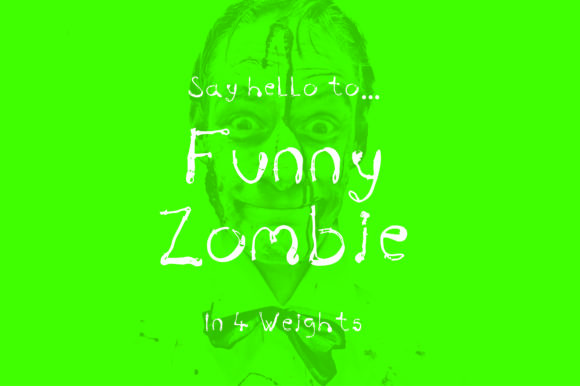
At first glance, Funny Zombie sounds like a meme-worthy mashup — part comedy sketch, part B-movie title. But in the world of typography, it’s something far more intriguing: a bold, rough, and intentionally weird handwritten font with an unmistakable scary touch. Designed to straddle the line between laughter and unease, Funny Zombie isn’t just another novelty typeface — it’s a deliberate stylistic rebellion against polished minimalism, offering designers, educators, marketers, and hobbyists a uniquely expressive tool for grabbing attention and evoking mood.
What Exactly Is Funny Zombie?
Funny Zombie is a display font crafted to mimic the erratic energy of hand-drawn lettering — think shaky lines, uneven strokes, exaggerated serifs (or lack thereof), and intentional imperfections like ink blots, smudges, or “zombie-like” distortions. Its name isn’t ironic; it’s descriptive. The “funny” comes from its cartoonish exaggeration and off-kilter charm, while the “zombie” reflects its unsettling, slightly decayed aesthetic — crooked letters that look like they’ve crawled out of a crypt… but with a wink.
Unlike clean sans-serifs like Helvetica or elegant serifs like Georgia, Funny Zombie thrives on inconsistency. Capital “A”s might lean left while lowercase “g”s curl unnervingly right. Some characters appear freshly drawn; others seem half-erased or hastily scribbled. This isn’t a bug — it’s the core feature. It’s designed for impact, not readability at small sizes, making it ideal for headlines, posters, social media banners, and branding that wants to stand out — loudly and memorably.
Why Would Anyone Choose a “Scary” Font?
Here’s where context matters. “Scary” doesn’t mean universally frightening — it means mood-driven. In design, emotion is currency. A font like Funny Zombie communicates energy, irreverence, spontaneity, and even dark humor. It tells viewers: This isn’t corporate-speak. This is human, flawed, and full of personality.
Consider these real-world uses:
- Event posters for horror-comedy film festivals or improv nights — where campy tension and laughter coexist.
- Educational materials for middle-school science units on viruses or biology — using playful dread to spark curiosity about microbes or decomposition.
- Small business branding for quirky bakeries (“Zombie Doughnuts”), indie game studios, or escape rooms — reinforcing theme without saying a word.
- Social media graphics announcing limited-time drops, meme campaigns, or April Fools’ promotions — where visual surprise boosts engagement.
In each case, Funny Zombie isn’t chosen to scare — it’s chosen to resonate. It aligns visual language with emotional intent, turning typography into storytelling shorthand.
How Funny Zombie Fits Into Modern Design & Communication
We live in an age of algorithmic sameness. Scroll through any app store, streaming platform, or news feed, and you’ll see hundreds of interfaces built on identical geometric fonts and predictable color palettes. That uniformity breeds fatigue — and indifference. Enter expressive typefaces like Funny Zombie. They serve as visual punctuation: brief, bold, and impossible to ignore.
From a business perspective, standing out isn’t optional — it’s essential. Brands competing for attention in crowded digital spaces benefit from distinctive voice cues, including typography. A well-placed Funny Zombie headline on a TikTok ad can stop a scroll faster than a generic sans-serif ever could — especially among Gen Z and younger millennials who value authenticity, irony, and stylistic risk.
In education, research shows that emotionally engaging stimuli improve memory retention. A teacher using Funny Zombie for a “Spooky Science Week” banner taps into that principle — the slight cognitive dissonance (“Why does this look fun but creepy?”) primes students’ brains for deeper processing. It’s not frivolous decoration; it’s pedagogical intentionality disguised as fun.
And for creators and developers, Funny Zombie offers flexibility beyond print. With modern web font support (via @font-face or services like Google Fonts alternatives), it integrates smoothly into HTML/CSS projects — perfect for animated SVG headers, interactive landing pages, or gamified learning modules where tone matters as much as content.
Common Misconceptions — And Why They Matter
Let’s clear up some frequent assumptions:
- “It’s only for Halloween.” While seasonally fitting, Funny Zombie’s utility spans year-round themes: rebellion, transformation, absurdity, resilience, or even satire. A climate change campaign titled “The Planet Is Waking Up… and It’s Not Happy” gains rhetorical weight with this font — not because it’s spooky, but because it feels urgent and alive.
- “It’s unprofessional.” Professionalism isn’t defined by uniformity — it’s defined by appropriateness. Using Funny Zombie on a law firm’s legal brief would be misguided. But deploying it in a startup’s pitch deck to signal innovation, disruption, and creative confidence? That’s strategic professionalism.
- “Handwritten fonts are always hard to read.” Yes — at small sizes or in long paragraphs. That’s why Funny Zombie is classified as a display font. Its purpose isn’t body text. Confusing display and text fonts is like using a sledgehammer to hang a picture frame: the tool isn’t wrong — the application is.
Practical Tips for Using Funny Zombie Effectively
Ready to try it? Here’s how to harness its power without sacrificing clarity or credibility:
- Pair it wisely. Contrast is key. Set Funny Zombie headlines against clean, neutral fonts like Open Sans or Lato for body copy. This creates visual hierarchy and prevents sensory overload.
- Limit its use. One dominant headline per layout is enough. Overuse dilutes impact and risks appearing gimmicky.
- Test legibility across devices. Zoom in on mobile previews — does the “zombie” texture still read as intentional, or does it blur into noise? Adjust letter-spacing (
letter-spacing: 1px;) if needed. - Respect licensing. Funny Zombie is often available under SIL Open Font License or commercial-use licenses. Always verify permissions — especially for client work or merchandise.
More Than Just a Font — A Cultural Signal
Funny Zombie reflects broader cultural shifts: our growing appetite for imperfection (think Instagram’s rise of “authentic” over “polished”), the normalization of dark humor as coping mechanism, and the blending of genres — horror + comedy, analog + digital, chaos + control. It’s typography that doesn’t ask permission to be seen. It barges in, grins crookedly, and makes you pay attention.
That’s its real superpower — not scariness, not silliness, but memorability rooted in emotional honesty. In a world saturated with AI-generated sameness, fonts like Funny Zombie remind us that human hands — shaky, strange, and wonderfully weird — still hold irreplaceable creative authority.
So next time you’re choosing a font, ask yourself: What feeling do I want people to feel before they even read the words? If the answer involves laughter, shivers, curiosity, or a delighted double-take — you already know which undead handwriting to call.