Bertilda Script: Elegant, Expressive, Timeless
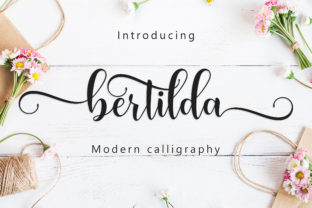
There’s a quiet confidence in handwriting that feels personal, intentional, and human — and Bertilda Script captures that essence with remarkable clarity. It’s not just another script font. Designed with subtle contrast, graceful entry and exit strokes, and carefully tuned spacing, Bertilda Script balances elegance with legibility — a rare pairing that makes it instantly useful across real-world projects.
Unlike highly ornamental scripts that sacrifice readability at small sizes or on screens, Bertilda Script maintains its charm from headline to caption. Its lowercase letters flow naturally, while capitals carry presence without dominance. That balance is why designers, educators, and small business owners alike reach for it when they need warmth *and* professionalism — not one at the expense of the other.
Where Bertilda Script Shines Most
Bertilda Script works especially well where tone and trust matter: brand identities for wellness studios, boutique packaging, wedding stationery, educator newsletters, or handmade product labels. Its rhythm invites attention without shouting — ideal for audiences who value authenticity over flash.
Consider a local ceramics studio launching a new line of hand-thrown mugs. Using Bertilda Script for the logo and product tags adds tactile resonance — as if the lettering itself were shaped by hand. Pair it with a clean sans-serif (like Inter or Lato) for body text, and you create visual hierarchy that feels intentional, not arbitrary.
Practical Pairings That Just Work
Typography pairing isn’t about rules — it’s about contrast with purpose. Bertilda Script pairs beautifully with:
- Neutral sans-serifs (e.g., Poppins, Montserrat, or Open Sans) for clean, modern balance;
- Gentle serifs (e.g., Merriweather or PT Serif) for editorial warmth and readability;
- Monospaced fonts (e.g., JetBrains Mono or Fira Code) for creative contrast in tech-adjacent branding or portfolio headers.
Avoid pairing Bertilda Script with other scripts or overly decorative fonts — the result often feels crowded or indecisive. Let it lead. Give it room to breathe in layout, line height, and spacing.
Real Projects, Real Results
Bloggers and content creators use Bertilda Script for newsletter headers, featured quote graphics, or episode titles in podcast show notes. One food blogger applies it to recipe cards — not for full body text, but for dish names and seasonal descriptors (“Summer Berry Galette”, “Roasted Carrot & Harissa Dip”). The effect? Immediate visual pause — readers slow down, linger, connect.
Educators integrate Bertilda Script into classroom posters, student certificates, or digital lesson slides — always at 24pt or larger. Its gentle curves reduce visual fatigue compared to sharp, high-contrast scripts, especially for younger learners or neurodiverse students.
Freelancers and small studios embed Bertilda Script into proposal covers, service page headlines, or client presentation decks. It signals care in craft — not just what you do, but how thoughtfully you present it.
What to Watch For (So It Stays Effective)
Bertilda Script thrives in context — but misused, even beautiful type can confuse. Keep these practical checks in mind:
- Size matters: Use at 20pt minimum for print, 24px minimum for web headings. Never for long paragraphs or footnotes.
- Color contrast is non-negotiable: Ensure at least 4.5:1 contrast against backgrounds (test with free tools like WebAIM Contrast Checker). Light gray on white won’t cut it — even if it looks “soft”.
- Limit weight variation: Bertilda Script includes regular and bold weights — use bold sparingly, only for emphasis within short phrases. Overuse flattens its nuance.
- Test on multiple devices: What reads gracefully on desktop may tighten awkwardly on mobile. Preview in Safari, Chrome, and native email clients before finalizing.
Variations You Can Build On
Bertilda Script isn’t static — it invites thoughtful adaptation. Try these grounded, scalable approaches:
- Letter-spacing adjustment: Slightly tighter tracking (+5–10 units) creates cohesion in logos; looser tracking (–20–30 units) adds air and elegance to invitation headers.
- Color layering: Apply a soft shadow or subtle gradient to Bertilda Script in digital banners — not for decoration, but to lift text off busy backgrounds while preserving clarity.
- Crop + focus: In social media graphics, isolate a single word — like “Gather”, “Create”, or “Begin” — in Bertilda Script against negative space. That focused use builds recognition faster than full sentences.
For Teams and Consistency
If you’re using Bertilda Script across a team — say, in a school district’s communications or a co-op’s shared brand kit — document usage clearly. Define exactly where it appears (e.g., “All event posters: Bertilda Script for title only; body copy in Nunito”) and provide downloadable assets with clear naming conventions (e.g., “BertildaScript-Bold_v2.woff2”). Consistency grows from structure, not assumption.
One small design agency shares a Figma library with preset Bertilda Script styles — including approved sizes, colors, and spacing presets — so junior designers and contractors align instantly. No guesswork. Just clarity, applied.
Getting Started — Without Overthinking
You don’t need a full rebrand to begin. Start small:
- Add Bertilda Script to your next Instagram Story highlight cover — just your name or a core value (“Clarity”, “Care”, “Craft”).
- Swap your email signature’s plain font for Bertilda Script in the name line only.
- Use it in a Canva template for client onboarding checklists — again, only for section headers like “Let’s Begin” or “Next Steps”.
Each use builds familiarity — with your audience, and with how the font behaves in your hands. That fluency leads to bolder, more confident applications later.
Bertilda Script doesn’t ask you to reinvent your voice — it helps you express it more clearly. Whether you're designing a book cover, writing a workshop syllabus, or labeling artisan soap bars, it offers a quiet kind of power: the power of intention, rendered in form. Choose it not because it’s trendy, but because it fits — genuinely, functionally, and beautifully — where your work meets the world.