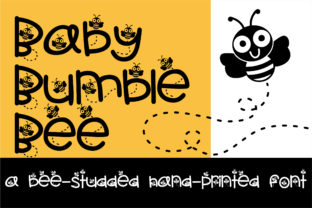
Baby Bumble Bee
If you’ve ever scrolled through font marketplaces and paused at a cheerful, hand-drawn bee motif dancing across the preview — complete with tiny wings, antennae loops, and honeycomb-shaped dots — you’ve likely stumbled upon Baby Bumble Bee. It’s not just another playful script. This is an exceptionally detailed handwritten font where every glyph feels like it was sketched by a joyful, slightly mischievous beekeeper who also happens to love watercolor textures and subtle imperfections.
People reach for Baby Bumble Bee when they want warmth without cliché, whimsy without clutter, and charm that still reads clearly — whether on a baby shower invitation, a small-batch honey label, or a kindergarten classroom poster. Its appeal spans educators designing learning aids, indie makers branding handmade goods, bloggers crafting Pinterest-friendly quote graphics, and even marketers refreshing seasonal email headers. But here’s what many don’t realize until after download: this font’s delightful details demand thoughtful use — not just enthusiastic clicking.
Assuming It Works Like Any Other Handwritten Font
Baby Bumble Bee includes extensive OpenType features — alternate glyphs, ligatures, swashes, and contextual substitutions — but only if your software supports them (and you know how to access them). Many users install it, type “Hello,” and wonder why the letters look flat and generic. That’s because the magic lives in the extras: the looping “g,” the dotted “i” shaped like a pollen sac, or the tail of the “y” that curls into a tiny hive pattern.
Better approach: Before using Baby Bumble Bee in a project, open it in a capable app like Adobe Illustrator, Affinity Designer, or even recent versions of Canva (with desktop app enabled). Type a short phrase, then explore the Glyphs panel or OpenType menu. Try toggling stylistic sets — especially “Swash Lowercase” or “Honeycomb Dots.” You’ll instantly see how much richer the type becomes when used as intended.
Overlooking Legibility at Smaller Sizes
This font shines at 24–60 pt — think greeting card headlines, product tags, or social media banners. But shrink it below 14 pt for body text or fine print, and those charming details start to blur: antennae merge with stems, wing outlines vanish, and the delicate “a” or “e” can become ambiguous. One educator printed Baby Bumble Bee on student name tags at 10 pt — only to find kids mixing up names during roll call.
That doesn’t mean Baby Bumble Bee is “unusable” for smaller applications. It means it needs pairing. Use it for headings, labels, or decorative accents — then switch to a clean, friendly sans-serif (like Quicksand, Nunito, or even Inter) for supporting text. This contrast preserves personality *and* clarity.
Misjudging Licensing Scope
Baby Bumble Bee is often sold with tiered licenses — personal, commercial basic, and extended. A freelance designer once used it on a client’s Shopify product page, assuming “commercial” covered all web use. But the license required an additional web font license for live embedding (via @font-face), not just static image exports. The site loaded fine — until the client launched a newsletter campaign pulling the same font from their server, triggering a compliance notice.
Always check two things before purchase:
- Whether your intended use falls under “digital display” (e.g., images, PDFs, presentations) or requires “web font” or “app embedding” rights;
- If the vendor provides a clear, written license summary — not just a vague “for commercial use” tagline.
Ignoring Color & Background Contrast
Baby Bumble Bee’s fine lines and organic edges rely on strong contrast to stay crisp. On light backgrounds, deep charcoal or black works beautifully. But try it in pale yellow on cream paper, or soft peach on off-white digital cards? The delicate wing strokes and pollen-dot accents fade — sometimes nearly disappearing. One bakery owner used it on eco-friendly kraft packaging with warm beige ink, only to discover the text looked smudged (not artistic) under store lighting.
Test early and physically: print a sample on your actual material, or view it on multiple screens. For digital use, check contrast ratios using free tools like WebAIM’s Contrast Checker. Aim for at least 4.5:1 for normal text. When in doubt, deepen the font color — not the background.
Skipping Kerning & Spacing Adjustments
Like many expressive handwritten fonts, Baby Bumble Bee ships with default spacing optimized for rhythm, not uniformity. That means “VA” might nest tightly, while “To” could feel awkwardly distant. Auto-kerning in some apps won’t fix it — especially with ligatures active.
Instead of accepting defaults, manually adjust tracking for headlines (try –20 to –50 units depending on size), then fine-tune problematic pairs with kerning values. In Illustrator, select two adjacent letters, open the Character panel, and use the kerning field (Alt+Left/Right Arrow). You’ll gain control without sacrificing charm.
Forgetting Print-Specific Prep
When sending Baby Bumble Bee to print — especially for foil-stamped stationery or letterpress — outline the text *before* exporting to PDF/X-4. Otherwise, the printer’s system may substitute a fallback font if the file isn’t embedded correctly. And because Baby Bumble Bee includes subtle texture overlays in some versions, confirm with your printer whether those are vector-based (safe) or raster (may require high-res PNG export).
A small business owner learned this the hard way: her “Baby Bumble Bee” wedding suite arrived with smooth, generic-looking script instead of the expected textured buzz. The fix? Outlining + embedding + a quick preflight check in Acrobat Preflight tool — all done before approving the proof.
Final Thought: Let the Bee Guide the Tone — Not the Entire Message
Baby Bumble Bee excels when it supports intent, not substitutes for it. It’s not a shortcut to “cuteness.” Used with care — correct size, smart pairing, intentional spacing, and appropriate licensing — it adds sincerity and delight. Used without attention, it can unintentionally signal informality where professionalism matters, or overwhelm where simplicity would resonate more.
So before you drop it into your next layout, ask:
- Does this serve the message — or distract from it?
- Will the audience read it easily, or pause trying to decode it?
- Have I verified it’s licensed for *how* and *where* it will appear?